

The first time I stood in a papermaker's workshop north of Kyoto, the sheets drying on boards looked like frozen milk. Hold one up to the window and the light does something strange: it stops being a beam and becomes a surface. That is the short answer to what is washi paper: traditional Japanese paper made by hand from the long inner-bark fibres of kozo (paper mulberry), mitsumata and gampi. Those fibres tangle into a thin, uneven sheet that is surprisingly strong and, above all, translucent. Light passes through it instead of bouncing off it. That is why a washi-covered lamp gives a soft, even glow rather than the flat, contained light of a fabric shade.
In short
- Washi simply means "Japanese paper": it is defined by its long bast fibres, not by rice.
- Kozo gives strength, mitsumata a soft sheen, gampi a fine translucency.
- The uneven fibre web scatters light in every direction, so a washi shade glows instead of blocking.
- Washi is not waterproof, but kept dry and away from heat it lasts for years.
What is washi paper, in plain terms?
Washi is paper made from plant bark rather than wood pulp, formed sheet by sheet on a screen by hand. The fibres come from the inner bark of shrubs and small trees, and they are long, flexible and left largely intact. Nothing about it is machine-pressed flat. That is why a washi sheet has depth when you hold it to the light: you can see the fibres crossing, like a very fine web.
To understand washi fully, it helps to start with what the word itself means and what makes the fibres so different from Western paper. These foundations explain everything that follows about how it behaves in a room.
Washi means "Japanese paper": what the word covers
"Wa" means Japanese, "shi" means paper. The word covers a whole family: thick sheets for sliding screens, tissue-thin sheets for conservation, textured sheets for lamps and boxes. What unites them is the raw material and the hand-forming method. Two sheets from the same workshop will differ slightly in tone and thickness, and that is normal.
Why washi paper feels thin yet tears so slowly
Most Western paper is made from wood pulp, where fibres are cut short. Washi uses bast fibre, the long structural fibre from inner bark, kept several millimetres long. Long fibres interlock, so a tear has to work its way around them instead of running straight through. Thin does not mean fragile here.
Kozo, mitsumata, gampi: the three washi fibres
The plant decides the character of the sheet. This matters because it changes how a lamp reads in a room: warmer or cooler, more opaque or more veiled. Papermakers choose fibre the way a joiner chooses oak or pine, for behaviour rather than for looks alone.
Each of the three main fibres creates a distinct personality in light and touch. Knowing these differences helps when you are choosing which shade will work best in your space.
Kozo washi: the strong everyday sheet
Kozo is paper mulberry, the workhorse. Its fibres are the longest of the three, which gives a tough, slightly fibrous sheet. Traditional shoji paper, the white paper set into wooden sliding screens, is usually kozo. It diffuses light generously and stands up to handling.
Mitsumata washi: softness and a faint sheen
Mitsumata fibres are shorter and finer. The sheet feels smoother under the fingers, denser, with a faint quiet sheen. It takes ink beautifully, which is why it has long been used for printing and fine stationery. Behind a bulb, mitsumata reads slightly creamier than kozo.
Gampi washi: the finest, most translucent paper
Gampi resists cultivation and is largely gathered wild, so it is rarer. The paper it makes is thin, smooth, almost glassy, with a natural translucency that conservators prize for repairing artworks. You rarely see a whole lamp in gampi, but a tissue-fine layer where transparency is the point.
| Fibre | Look and feel | Light through it | Typical use |
|---|---|---|---|
| Kozo (paper mulberry) | Fibrous, matte, sturdy | Broad, milky diffusion | Shoji screens, lamp panels, scrolls |
| Mitsumata | Smooth, dense, slight sheen | Warmer, creamier glow | Printing, fine papers, small shades |
| Gampi | Very thin, silky, crisp | Near-transparent, sharp | Conservation, layering, overlays |
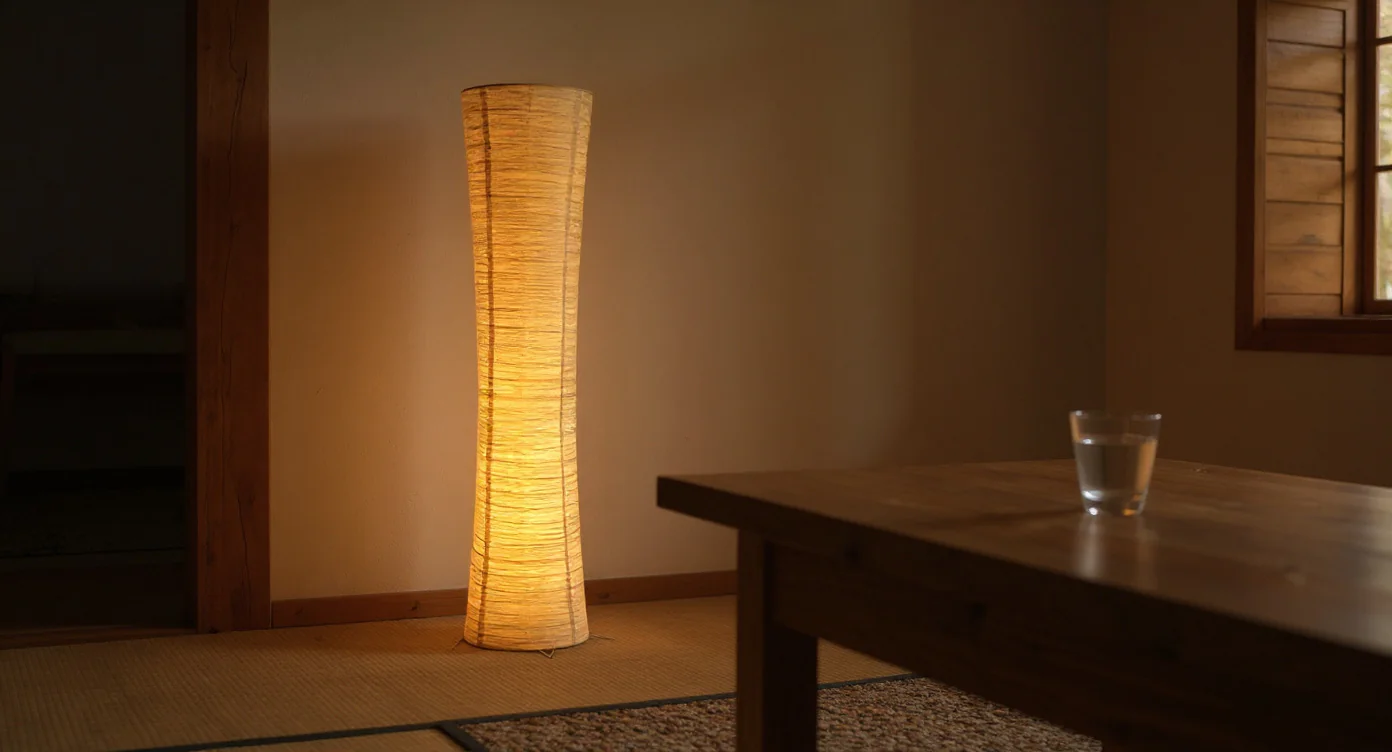
On a simple frame, that fibre web is the whole story. When someone asks me for a first paper light, I usually point them to a minimalist floor lamp with a plain cylindrical shade, because there is nothing else competing: you see the paper, the grain of its fibres, and the light coming through it.

How washi paper is made, from bark to sheet
Every quality you notice in a finished washi panel comes from a physical step you can watch in a workshop. The process is slow, wet and largely unchanged.
The journey from raw bark to finished sheet involves several precise steps, each one contributing to the paper's strength and light-diffusing power. Walking through a workshop, you can see how intention shows in the finished object.
Steaming, stripping and beating the inner bark
Branches are cut, steamed, and the bark peeled off in long ribbons. The dark outer layer is scraped away, leaving the pale inner bark. That bark is cooked in an alkaline solution to loosen the fibres, then rinsed and picked over by hand. Finally it is beaten, traditionally with wooden mallets, which separates the fibres without cutting them short. Beating, not grinding, is why kozo mulberry fibre stays long.
Neri and the nagashizuki sheet-forming motion
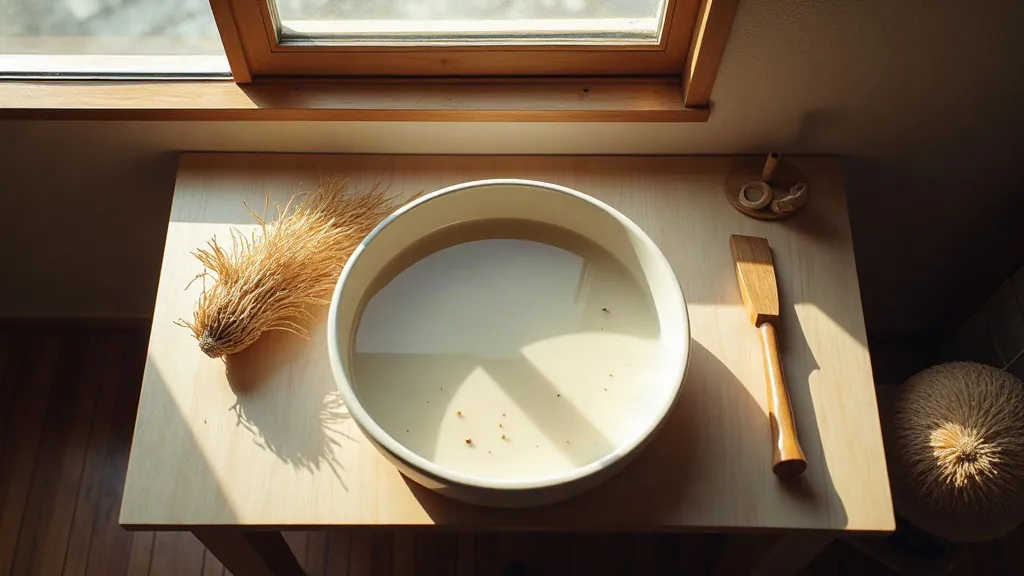
The beaten fibre is stirred into a vat of water with a viscous plant mucilage, tororo-aoi (neri), made from the root of a hibiscus. It thickens the water so fibres float evenly. The papermaker scoops the mixture onto a bamboo screen and rocks it forward, back, side to side, letting excess drain off. This is nagashizuki papermaking, and the swaying lays fibres in crossing directions, which makes the sheet strong and the light diffusion even.
Why hand-formed washi has no perfect edge
Sheets are couched into a stack, pressed gently, then brushed onto boards or dried on heated plates. The edge where the pulp thinned out on the screen stays soft and slightly ragged: the deckle edge. Thickness varies slightly across the sheet too. In a lamp, that variation shows as faint clouding when lit. It is the fingerprint of the maker's rhythm, not a flaw.
Is washi paper the same as rice paper or origami paper?
No. "Rice paper" is a shop label, not a material, and origami paper is a format rather than a fibre. Both terms are used loosely in English, which makes many listings vague.
The confusion matters in practice. When you are choosing a shade or a sheet for repair work, knowing what you are actually buying protects you from disappointment. Here is what each term really covers.
Washi vs rice paper: what the confusion hides
"Rice paper" covers at least three unrelated things: edible rice-starch wrappers used in cooking, pith sheets from a Taiwanese shrub, and thin Asian art papers sold under a catch-all name, including Chinese xuan paper made from bamboo and sandalwood bark. Washi contains no rice. If a lamp is described only as "rice paper", ask what the fibre actually is.
Washi vs origami paper: same sheet, different job
Some origami paper genuinely is washi, cut into squares. Most origami paper sold today is machine-made from wood pulp, printed on one side, chosen for crisp folds and flat colour. Folding paper needs to hold a sharp edge. Lamp paper needs to spread light. Those are different requirements.
| Made from | Made how | Best at | |
|---|---|---|---|
| Washi | Kozo, mitsumata, gampi bark | Hand-formed, sheet by sheet | Diffusing light, strength, repair |
| "Rice paper" | Varies: rice starch, pith, bamboo, bark | Varies widely | Nothing specific, the term is unreliable |
| Origami paper | Usually wood pulp | Machine-made, cut to squares | Holding a sharp crease |
Why a washi lamp shade softens light more than fabric
Put a linen shade and a washi shade side by side in a dim room and the difference is immediate. The linen throws two clear cones, up and down. The washi shade becomes a lit object in itself, and the whole corner lifts. The reason is structural.
The way washi scatters light changes not just the quality of illumination but how a room feels and how you position the lamp. Understanding this distinction helps when you are planning a corner that needs calm.
Washi paper diffuses light instead of blocking it
Woven fabric is a grid: warp and weft, regular openings, opaque threads. Light either passes through the gaps or is absorbed by the yarn, so it stays fairly directional. Washi has no grid. Its fibres run every which way at varying densities, and each one scatters the light it meets. The result is light diffusion across the entire surface, with no visible hot spot from the bulb.
Fabric shades, washi shades: the light they leave in a room
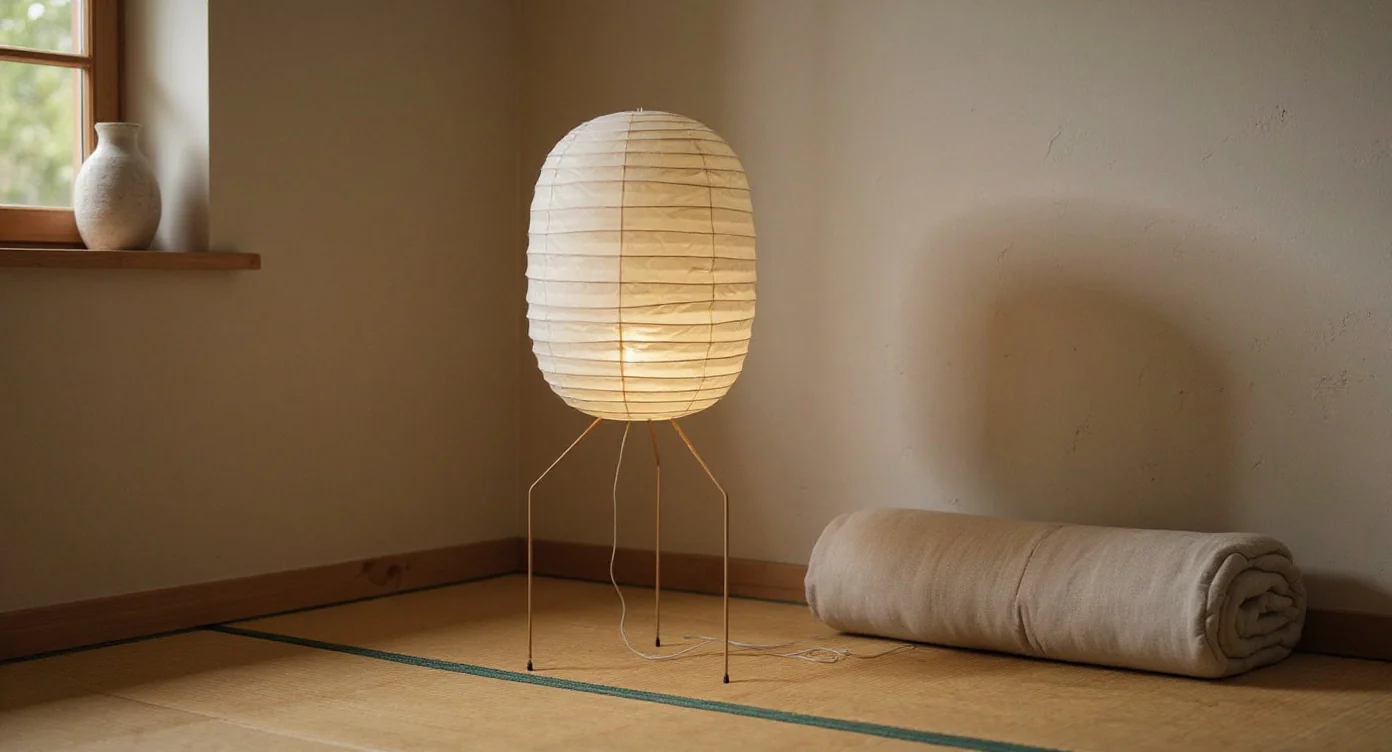
This changes how you place the lamp. A fabric shade wants to sit near what it lights. A paper shade can stand slightly away from the wall and wash it gently, softening the corner and making a small room feel less boxed in. Shadows have softer outlines on a lime-plastered or pale wall. In a reading corner I styled last winter, I used a japandi floor lamp with a paper shade about thirty centimetres from the wall, and the halo it left did more for the room than the ceiling fitting ever had.

Bulb choice behind a washi shade: warmth and glare
Check the maximum wattage on the fitting and stay well under it. Paper and heat are not friends, and LED runs cooler than incandescent. A single low-output bulb behind washi usually reads brighter than people expect, because the whole surface is lit. If the shade seems too bright when you sit down, the answer is a dimmer or a lower lumen bulb, not a thicker paper.
| Shade material | Light quality | Best placed |
|---|---|---|
| Washi paper | Even glow, whole surface lit, soft shadows | Dark corner, beside a low chair, near a pale wall |
| Linen or cotton | Directional cones, darker mid-band, warmer cast | Beside a reading seat or a side table |
| Opal glass | Smooth and even, but harder-edged and cooler | Hallways, kitchens, anywhere it may be wiped |
Living with washi: is washi paper waterproof and how to care for it
Washi is not waterproof. It is paper, and water swells the fibres and marks the surface. Traditional treatments exist to make paper water-resistant, but standard lamp washi has none of that. Plan its place accordingly and it will ask almost nothing of you.
Caring for washi is less about doing things and more about choosing its location wisely. A few simple precautions keep a shade serving quietly for years.
Washi paper and water: humidity, splashes, kitchens
Keep it out of bathrooms, away from a kitchen sink and away from an open window that gets rain. Steady humidity is fine; splashes and standing damp are not. A drop that dries will usually leave a faint ring. If a panel gets damp, let it dry slowly in still air rather than near a radiator, which cockles the surface.
Dusting, repairing and replacing a washi panel
Dust with a soft dry brush, working downward in one direction. No cloth, no water, no spray. Small tears are repairable: a thin strip of washi and a little starch paste, applied from the inside, and the long fibres knit back together with a mend that is barely visible when lit.
Where a washi shade works best in a home
The dark corner of a living room, first of all, where a paper shade earns its place by lifting the whole area. Then beside a low bed, where you want light without glare, and next to a reading chair, set slightly behind your shoulder. In home staging I use one to draw the eye to the far end of a room, giving a sightline something quiet to land on. One paper lamp and a lot of empty floor around it reads calmer than three small lights.
Washi paper: frequently asked questions
These questions come up often from people considering a washi shade for the first time or wondering how it compares to other materials. The answers are brief because the principles are straightforward.
What is washi paper used for?
Traditionally for sliding screens and doors, lamps and lanterns, hanging scrolls, calligraphy, printmaking, bookbinding, umbrellas and clothing. Today it is also used for conservation of books and artworks, packaging and fine stationery. In the home, its most common role is diffusing light.
Is washi paper the same as rice paper?
No. Washi is made from bark fibre, mainly kozo, mitsumata and gampi, and contains no rice. "Rice paper" is a loose English label applied to several unrelated papers, so it tells you very little about a product.
Is washi paper waterproof?
No. Untreated washi absorbs water and marks easily. Some traditional papers are treated with konnyaku starch or persimmon tannin to become water-resistant, but a standard lamp panel is not, so keep it dry.
Is washi paper the same as origami paper?
Not usually. Some origami squares are cut from washi, but most origami paper is machine-made from wood pulp and chosen for crisp folding and printed colour. Washi is defined by its fibre and hand forming, not by format.
How long does a washi lamp shade last?
Kept dry, dusted gently and used with a low-output warm bulb, a washi shade can serve for many years. It will yellow very slightly over time, which most people find pleasant. Panels can be repaired, and on some designs re-covered.
If a quiet corner in your home is asking for light rather than another object, the paper floor lamp collection is where I would start looking. Take your time with it, and consider the wall behind the lamp as part of the choice.
Explore the Paper Floor Lamp collection
See how paper shades behave in a real room, from bedside glow to a lit reading corner.
Browse the collection →