
The first time I whisked matcha in a cereal bowl, I got a grey, lumpy cup and a sprayed countertop. The bowl was too deep and its floor curved. Nothing was wrong with my technique. So, what is a chawan and why did it fix the problem in one gesture? A chawan is a Japanese tea bowl made for whisking matcha, not for holding soup or cereal. Its wide mouth gives the chasen room to move, its thick clay walls hold heat while your hands stay comfortable, and its footed base lets you lift and turn the bowl with control. Every proportion answers a gesture in the ritual, which is exactly what separates a chawan from an ordinary bowl.
In short
- A chawan is a tea bowl whose width, wall thickness and foot all serve the whisking gesture.
- Summer chawan are shallow and open to cool the tea; winter chawan are deep and narrow to hold heat.
- You can whisk matcha in any bowl, but a chawan makes a smooth, foamy result far easier.
- Shape, glaze and the kodai (foot ring) are what tell a chawan apart from a decorative bowl.
What is a chawan, and what is a chowan?
Chawan is written 茶碗 in Japanese. Cha means tea, wan means bowl. In potters' workshops, the word attaches to a shape, a clay body and a firing schedule rather than to a style.
Chawan vs chowan: the same bowl, two spellings
Chowan is not a separate object. It is a common misspelling, born from how the word sounds to an English ear. If you searched for a chowan, you were looking for a chawan.
The two families: matcha-jawan and meshi-jawan
In Japan, the word covers two different bowls. A meshi-jawan is the rice bowl: small, deep, narrow enough to hold in one palm. A matcha-jawan is the tea bowl: wide, low, heavy in the hand, sized for a whisk. The rest of this article is about the tea bowl, and every feature comes from a movement someone repeats.
Why a chawan is wide: room for the chasen
Width is the first thing you notice and the first thing that matters. Most matcha bowls measure roughly 11 to 13 cm across the mouth and around 7 to 8 cm tall. That ratio is not decorative. It gives the whisk a clear working zone and keeps the tea shallow enough to aerate quickly.
How bowl width changes the whisking motion
Matcha is whisked in a fast back-and-forth W or M motion, from the wrist, not stirred in circles. The chasen bamboo whisk has around 80 to 120 fine split tines, and they need space to open and spring back. In a narrow bowl the tines drag on the wall, splay out and break early. Hold the whisk upright in the bowl and move it a few centimetres left and right. If it touches the sides, the bowl is too tight.
The flat inner floor where the matcha gathers
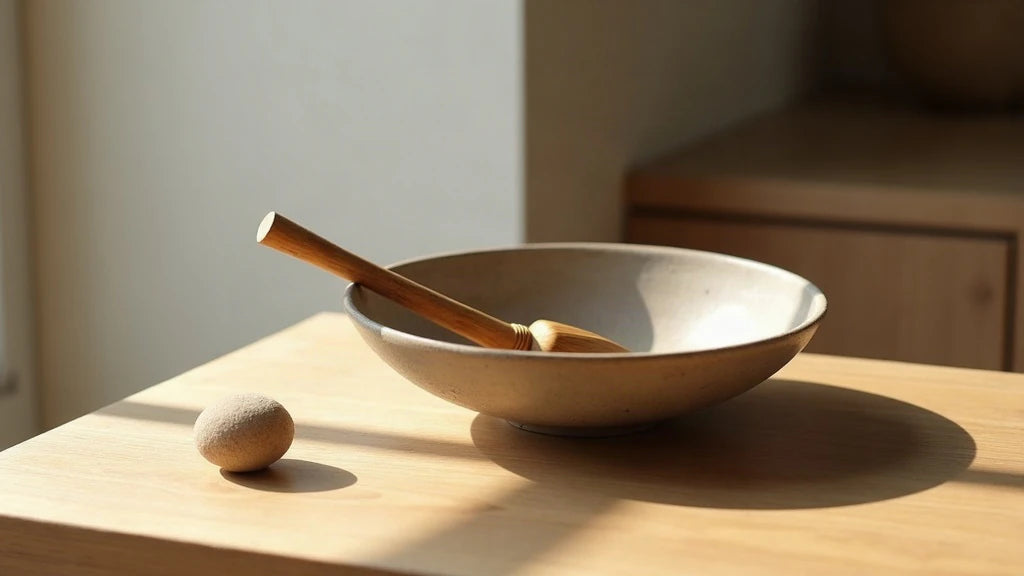
Look inside a good tea bowl and you will find a flat or gently dished floor, called the chadamari, where the last of the tea pools. That flat area lets the tines sweep along the base and lift the powder that always settles there. Curved-bottom bowls trap clumps in the crease. A bowl like this green matcha one has a wide, level base where the whisk can actually reach the powder.
Volume matters too. A chawan is generally filled only a third of the way. The empty space above the tea is working space, the same way negative space in a room is working space.
Thick walls and the foot: how a tea bowl handles heat
Pick up a chawan and it feels heavier than it looks. That weight is thermal mass. Thick clay absorbs heat slowly, then gives it back slowly, so the tea stays warm through the whisking and the first sips.

Why chawan clay is thicker than a soup bowl
Matcha for everyday drinking is whisked with water around 70 to 80 °C, cooler than boiling. In a thin porcelain bowl that temperature drops fast. In a bowl of dense stoneware clay, it holds. The same thickness protects your palms: you can cradle the bowl with both hands without flinching. The rim is usually thinner and slightly flared, so the lip meets your mouth cleanly.
The kodai foot ring and the two-hand grip
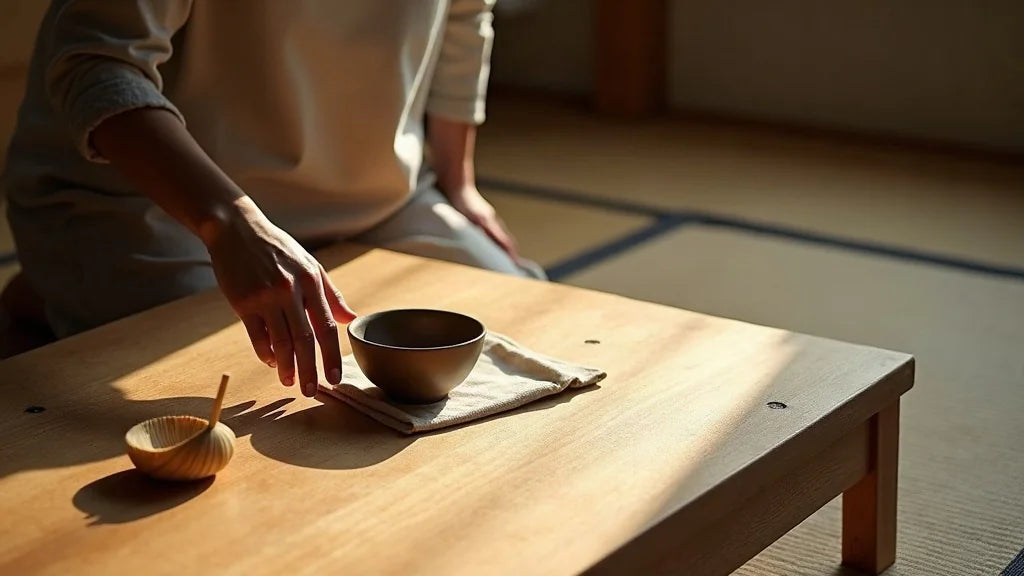
Underneath, a chawan stands on a carved ring rather than a flat base. This is the kodai (foot ring). It lifts the hot body of the bowl off the table, so wood surfaces stay unmarked. It also gives your fingers something to catch when you lift the bowl or rotate it before drinking, a gesture that belongs to chanoyu, the Japanese practice of preparing tea.
The foot is almost always left unglazed. Practically, a glazed foot would fuse to the kiln shelf. Culturally, it is the one place where the raw clay shows: its colour, its grit, the spiral of the trimming tool. Potters know their bowls are read from underneath.
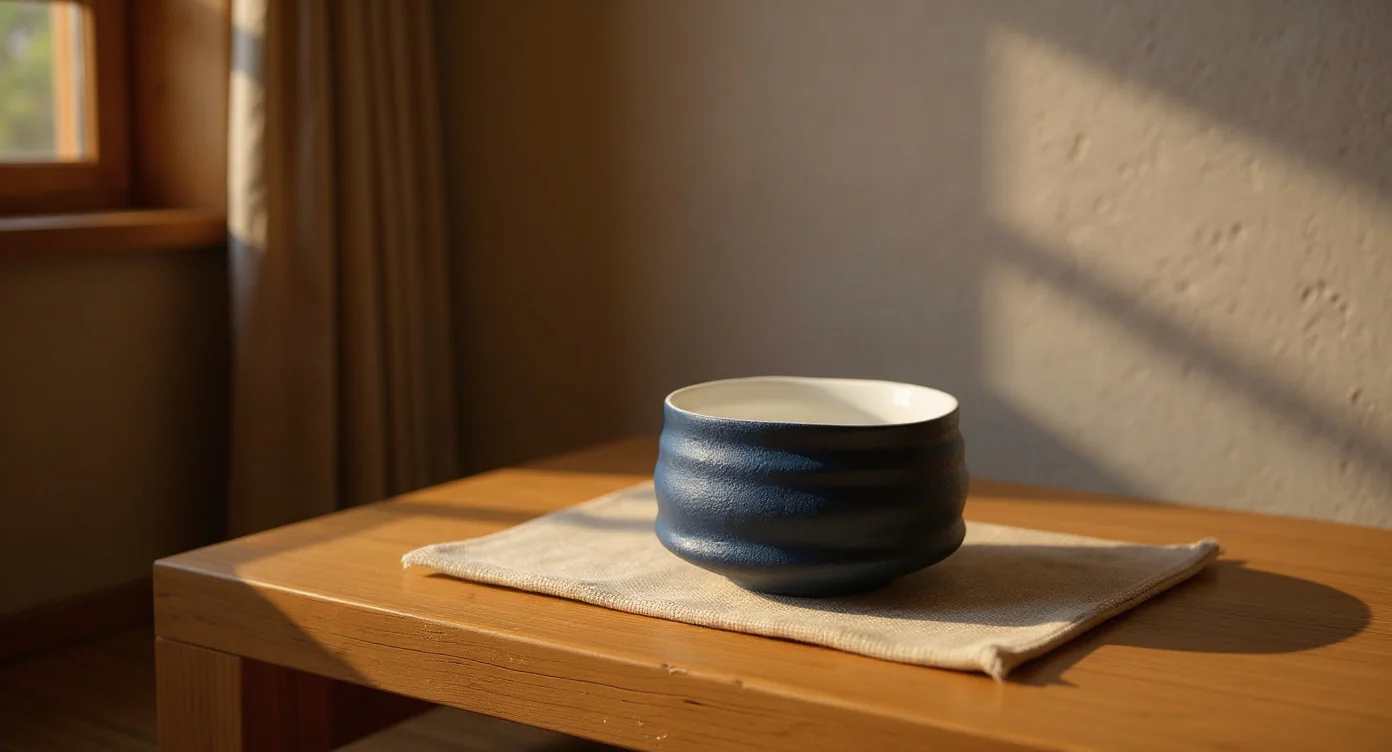
Summer vs winter chawan: why the seasons change the shape
The season is the reason two chawan can look like different objects. In summer you want tea to cool quickly. In winter you want it to stay hot in your hands. Potters solved both with geometry: more surface area, or less.
| Bowl | Shape | Effect on the tea | In the hand |
|---|---|---|---|
| Natsu-jawan (summer) | Wide and shallow, sometimes almost a flat dish | Large exposed surface, tea cools fast, green colour visible across the whole bowl | Light, held from below, open |
| Fuyu-jawan (winter) | Deep and narrow | Small opening, slower heat loss, tea stays warm longer | Wraps the palms, warms the fingers |
| Year-round bowl | Medium depth, 11 to 12 cm across, flat inner floor | Balanced: enough room to whisk, enough depth to hold heat | Comfortable with two hands, easy to lift |
The shallow natsu-jawan for hot months
A natsu-jawan (summer bowl) spreads the tea thin. You see the whole surface of the foam and the tea reaches drinkable temperature in under a minute. Whisking takes a lighter wrist, since a shallow pool splashes easily.
The deep fuyu-jawan that keeps tea warm
A fuyu-jawan (winter bowl) does the opposite. Less opening, more depth, more warmth held against cold hands. The trade-off is real: in a very narrow cylinder, the whisk has less freedom and the foam is harder to build.
Types of chawan: raku, hagi and other tea bowl styles
Families of chawan are named after the places and kilns where they were made. Each one changes the weight, the surface and the way the bowl ages.
Raku chawan and the hand-formed silhouette
Raku bowls are shaped by hand and knife rather than thrown on a wheel, then fired at low temperature and pulled hot from the kiln. The result is light, slightly irregular, soft to hold and warm to the touch. The walls often show finger pressure, which is the point.
Hagi, Karatsu and other traditions
Hagi ware, from the Yamaguchi region, uses a soft, porous body under a pale, crazed glaze. Tea seeps into those fine cracks over months and the bowl darkens gradually. Karatsu bowls are earthier and greyer, with iron-flecked clay and quiet glazes. Seto and Oribe bring green copper glaze and bolder painted marks.
Reading a chawan: glaze pooling and imperfection
The wabi-sabi eye, which values what is worn, uneven and honest, looks for exactly what mass production removes. A thicker run of glaze where it gathered near the foot. A rim that is not perfectly level. Throwing lines under the fingers. Two bowls from the same kiln that are not the same colour. Our own studio checks look for the opposite of uniformity: three passes to catch cracks, an unstable foot or a rough drinking rim, while leaving every colour variation intact.
Chawan or ordinary bowl: does matcha really need one?
No, it is not necessary. You can whisk matcha in a soup bowl and drink it happily. But you will feel the difference in three places: foam, clumps and temperature.
What goes wrong when you whisk in a mug or cereal bowl
A mug is too narrow: the whisk cannot travel, the tines bend against the wall, and the tea stays flat. A cereal bowl usually has a curved floor that hides lumps in the crease. A wide, thin soup bowl whisks reasonably well but loses heat in a minute.
| Vessel | Whisking room | Foam and texture | Heat retention |
|---|---|---|---|
| Chawan | Wide mouth, flat floor | Fine, even foam | Good, thick walls |
| Mug | Too narrow, damages the whisk | Little foam, frequent clumps | Good |
| Cereal bowl | Wide but curved base | Uneven, lumps in the crease | Average |
| Thin soup bowl | Usable | Acceptable foam | Poor, cools fast |
What a matcha bowl actually improves
A proper bowl makes a smooth cup easier on the first try, protects the bamboo whisk from splaying, keeps the tea warm to the last sip and gives the whole thing a place to happen. That last part is not decoration. A bowl kept out on a wooden shelf turns a two-minute habit into something you return to.
Chawan questions people ask before buying one
These are the questions that come up most often, answered briefly.
Is a chawan necessary for matcha?
Not strictly. Any wide, flat-bottomed bowl will get powder and water mixed. A chawan simply makes a smooth, foamy result far more reliable and keeps the tea hot while you drink it. If you make matcha more than once or twice a week, it repays itself quickly.
What size chawan should I buy?
Aim for roughly 11 to 13 cm across the mouth and 7 to 8 cm tall. That range fits a standard whisk with room to move and holds a comfortable serving without feeling half empty.
Can a chawan go in the dishwasher?
I wash mine by hand, always. Warm water, no soap, a soft cloth, then dry it upside down on a rack so the unglazed foot dries fully. Dishwasher heat and detergent can stain porous bodies like Hagi and dull a matte glaze over time.
Can I eat rice from a matcha chawan?
You can, though it will feel oversized and low. A rice bowl is deeper and narrower, made to be held in one hand while chopsticks work. Many of our bowls are used for small salads, soups or ice cream between tea sessions, and stoneware handles that without trouble.
If you are looking for a first bowl, or a second one for the colder months, our matcha bowls are grouped by shape and clay so you can compare width and depth before choosing. Take your time with it; one good bowl is enough.
Explore the Matcha Bowl collection
Browse the Matcha Bowl collection to compare widths, wall thickness and glazes bowl by bowl.
Browse the collection →