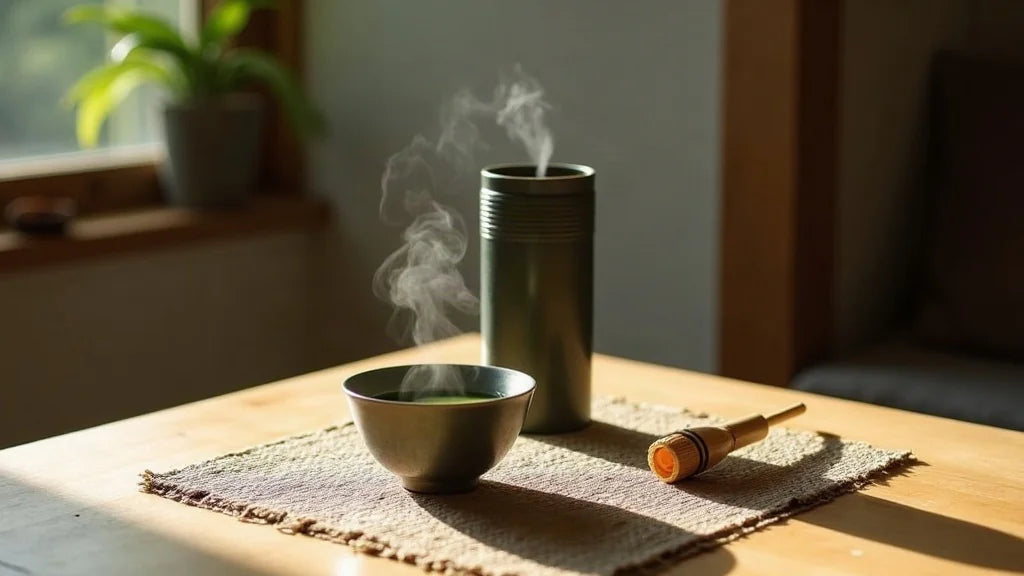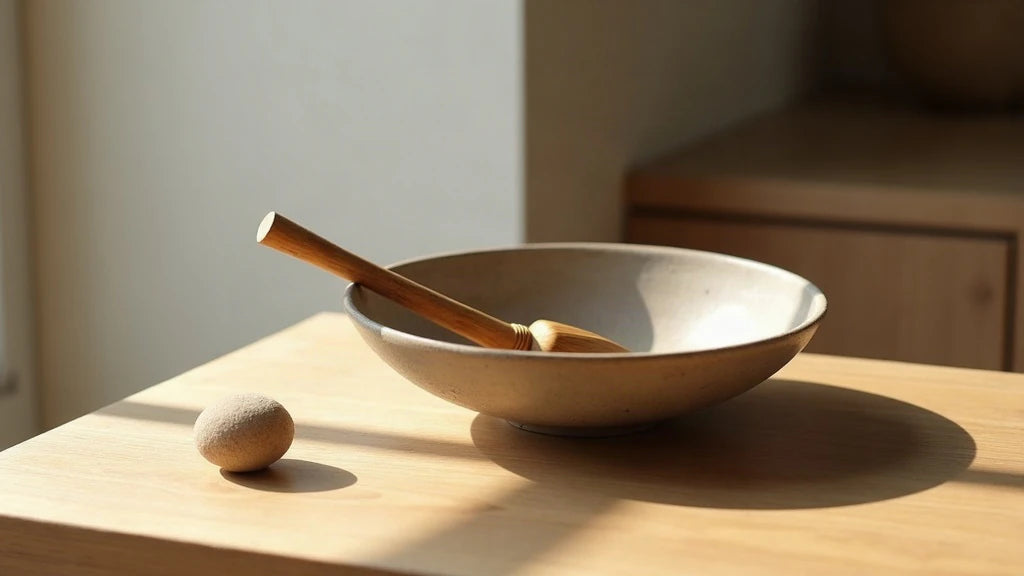

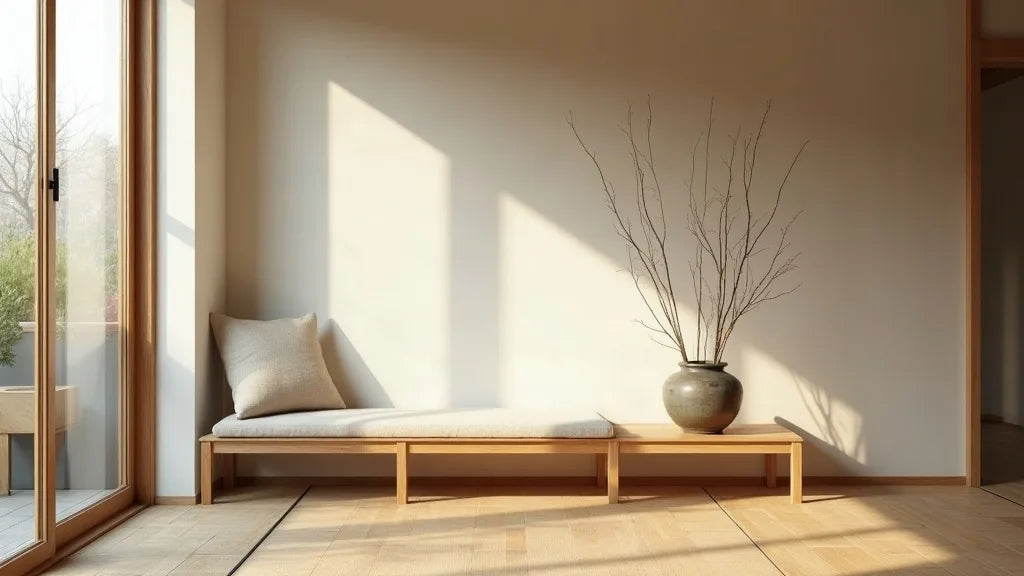
A cup with a glaze that pooled thicker on one side. A linen cushion that has stopped looking new. Those are the two objects I would keep if a client asked me to strip a room back to its bones. Wabi-sabi interior design is a way of furnishing a home around the beauty of imperfect, natural, ageing things: raw wood and clay, uneven glazes, linen that creases, empty space left on purpose, and soft daylight instead of bright overhead glare. It comes from a Japanese worldview shaped by the tea ceremony, where a cracked bowl mended with care is worth more than a flawless one. In practice it means fewer objects, chosen slowly, allowed to show their age.
In short
- Wabi-sabi decorating means choosing natural, handmade, imperfect pieces and letting them age visibly.
- Empty space, matte textures and low, warm light matter more than buying new furniture.
- Start with one room and one anchor object rather than a full makeover.
- Wabi-sabi is not japandi, zen or shabby-rustic: it keeps warmth, patina and asymmetry.
What is wabi-sabi interior design? A clear definition
It is a set of choices, not a look you buy in one afternoon. You keep what is honest, you remove what is loud, and you accept that surfaces will change.
Wabi and sabi: what each half of the word means
Wabi points to rough simplicity: modest, unpolished, quiet. Sabi points to the beauty time leaves behind: the darkened rim of a wooden tray, the softened edge of a stone step. Put together, the term describes an appreciation for things that are humble and visibly used.
The idea was shaped in sixteenth-century Japan by tea masters, Sen no Rikyū above all, who favoured plain local bowls and small, low-ceilinged tea rooms over imported perfection.
What the wabi-sabi aesthetic looks like in a room
Matte, never shiny. Low contrast, so the eye is not pulled to one bright spot. Shapes are slightly off-centre rather than mirrored. Surfaces read as one material all the way through: clay that is clay, wood that is wood, plaster that shows the trowel. The beauty of imperfection here is literal, a thumbprint left in the clay foot of a bowl, a knot the joiner chose not to hide.
Wabi-sabi design also means restraint in quantity. A shelf holds three objects, not eleven.
A concrete example of wabi-sabi in a home
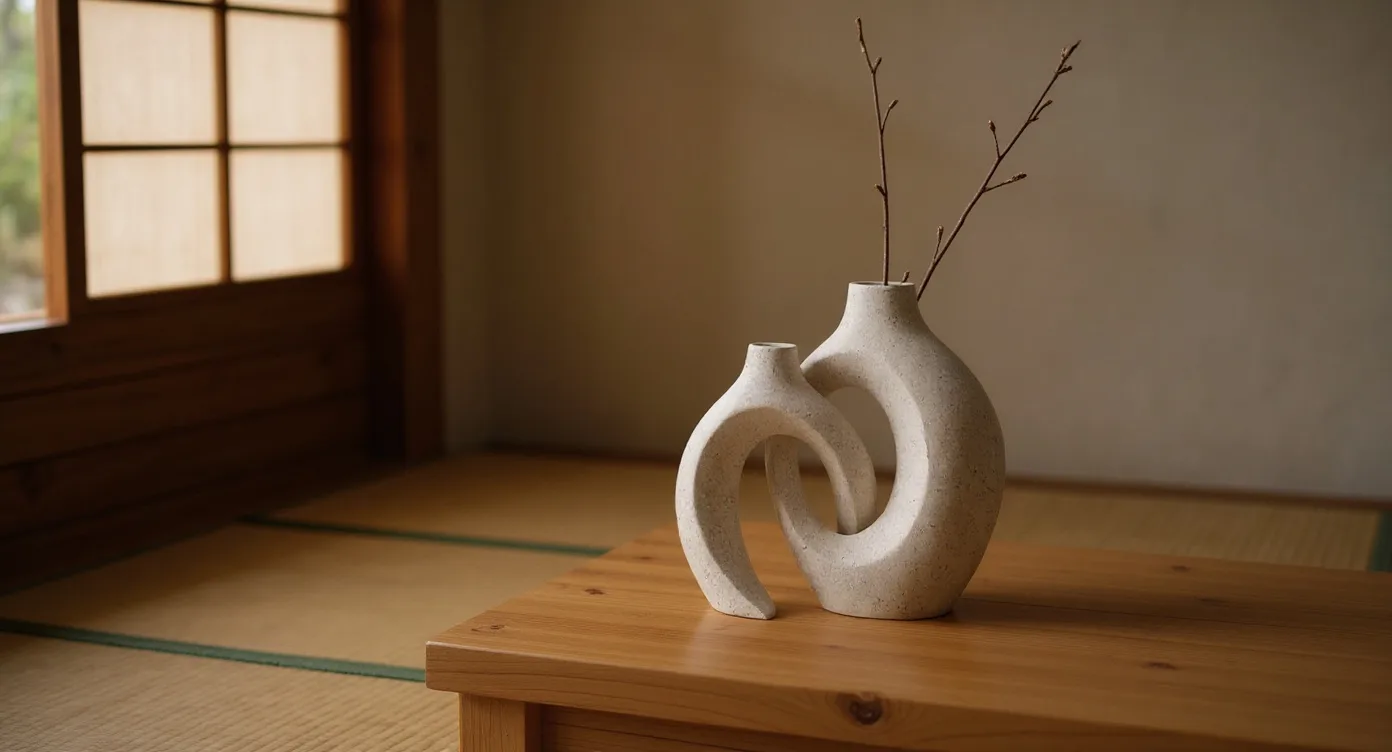
A console in raw oak against a lime-plastered wall. On it, one vessel with an irregular silhouette and a dry, matte surface, set slightly off-centre. Inside, a single bare branch, leaning. Nothing else on the console. In afternoon light the vessel throws one long soft shadow, and that shadow is half the composition. When a client wants a starting point I usually suggest a vase with an uneven, hand-shaped body, because a single irregular form on an empty surface teaches the whole principle faster than any moodboard.
The seven wabi-sabi principles inside a real room
The seven principles come from Japanese aesthetics and translate into measurable gestures: how many things on a shelf, how much floor stays bare, where the eye lands when you open the door. Below, what to do this weekend.

Imperfection and asymmetry in a wabi-sabi interior
Fukinsei means asymmetry, and shizen means naturalness without pretence. Stop pairing things. Remove one of the two matching lamps and move the remaining one off-centre. Group objects in odd numbers, at three different heights, on one side of the surface rather than the middle.
Shibumi, understated beauty, is the quality control step: if a piece announces itself from across the room, it is probably too much. Kanso, simplicity, is the sorting rule. One object earns its place, the second one has to justify itself against the first.
Emptiness: the space a wabi-sabi room needs
Aim to leave 30 to 40 percent of every horizontal surface bare. Shelves, sideboards, the coffee table, the kitchen counter. That deliberate emptiness is negative space, close to what Japanese design calls ma, the interval that gives the rest its weight.
Stand in the doorway and follow your own line of sight. The first three metres should be clear, with no object at eye level fighting for attention. Then check circulation, at least 60 to 70 cm of walking width around furniture. A room reads calm when the body can move through it without adjusting.
Patina: letting a wabi-sabi home age well
Sabi lives here. Choose finishes that improve as they mark: oiled wood, waxed stone, untreated brass, washed flax. Patina and ageing are the point, not a defect to correct.
Wabi-sabi materials, colors and light: what to pick
Material choice is where a wabi-sabi interior is won or lost. The test is simple: how will this surface look after three years of daily use.
Clay, stone, linen and wood in a wabi-sabi home
Work with a short list. Unglazed ceramics with a dry, porous surface. Stone with visible pores, travertine or slate. Washed linen and hemp textiles, which crease and soften rather than hold a crisp line. Oiled oak or ash instead of varnished wood, because varnish creates a plastic film that scratches white. Washi paper for shades, since it diffuses light with a warm grain.
For rituals I use a heavy piece rather than a light one. A stone incense burner is the object I recommend most often for a low side table, because raw stone holds a room down visually, and the thread of smoke reads beautifully against a lamp placed at floor level.

| Material | Look | Care | How it ages |
|---|---|---|---|
| Unglazed clay | Dry, matte, slightly porous | Rinse, no dishwasher for handmade pieces | Darkens gently, absorbs oils, gains depth |
| Raw stone | Visible pores, cool to the touch | Wipe with water, avoid acids | Edges soften, colour deepens where handled |
| Washed linen | Creased, low sheen, open weave | Machine wash cool, dry flat | Softens with each wash, colour fades evenly |
| Oiled oak | Open grain, warm, no film | Re-oil once or twice a year | Ambers with light, marks blend in over time |
The muted palette of a wabi-sabi interior
Think of a muted earth palette: off-white and unbleached, clay and terracotta, stone grey, sumi black used in small amounts, and one plant green. Keep contrast low and let texture do the work that colour does elsewhere.
The common error is cold grey. Blue-based greys turn the room flat and slightly clinical under evening light. Choose greys with a warm base, or test a sample on two walls before committing.
Low, warm light for a wabi-sabi room
Bulbs between 2200 and 2700 kelvin, which is candle to warm white. Never the ceiling fixture alone. Three or four low sources scattered around the room, at table height and floor height, create pools of light instead of one flat wash.
Daylight comes first. Use unlined linen curtains or paper screens rather than heavy blackout panels in living spaces, so the light stays diffuse through the day.
How to start a wabi-sabi interior, room by room
One room. One anchor object. A full makeover produces a stage set, while one room done slowly teaches you what you actually want in the next.
A wabi-sabi living room and reading corner
Remove the small decorative objects from the coffee table, all of them, and live with the empty surface for a week. Keep the worn armchair and have the seat re-stuffed rather than replacing it. Add one anchor: a large, low vessel on the floor, or a linen throw with real weight.
For the reading corner, keep it to three elements: a chair, a low light, a surface for a cup.
A wabi-sabi bedroom that stays quiet
Remove everything from the bedside table except a lamp and one small dish. Keep the mattress low, closer to the floor, which echoes the floor-level living of tatami rooms and lowers the visual centre of the room. Add washed linen bedding in an undyed tone and stop ironing it.
The wabi-sabi kitchen and tea corner
Clear the counter down to two or three daily objects. Keep the pan that has gone dark with use. Add a tea corner: a small tray, a kettle, one handmade cup, a caddy. That corner is the daily ritual that holds the rest together.
Wabi-sabi vs japandi, zen and rustic interiors
These four are often lumped together and they are not the same room. Knowing which one you actually want saves you a season of wrong purchases.
| Style | Palette | Materials | Emptiness | Feeling |
|---|---|---|---|---|
| Wabi-sabi | Warm earth, off-white, sumi | Clay, stone, linen, oiled wood | High, asymmetric | Quiet, worn, human |
| Japandi | More white, pale wood tones | Ash, oak, rattan, wool | High, tidy | Crisp, light, composed |
| Zen minimalism | Neutral, near monochrome | Stone, paper, dark wood | Very high, ordered | Formal, still, symmetrical |
| Farmhouse rustic | Cream, warm brown, pattern | Reclaimed wood, iron, ceramic | Low, layered | Full, cosy, collected |
Wabi-sabi or japandi: where the two styles split
Japandi is wabi-sabi filtered through Scandinavian design: cleaner lines, straighter edges, more white, more visible function. Wabi-sabi keeps the wobble. If your eye wants a perfectly aligned sideboard on tapered legs, you are in japandi. If you want a bench with a live edge, you are not.
Wabi-sabi vs zen minimalism
Zen interiors aim at order and balance, often symmetrical, often close to empty. Wabi-sabi is warmer and less controlled. A zen room is swept smooth, a wabi-sabi room keeps the trace of use.
Wabi-sabi vs farmhouse rustic
Both love old wood, and that is where the overlap ends. Rustic accumulates: pattern, collections, decorative detail. Wabi-sabi subtracts, and one worn table in an otherwise bare room does more than ten rustic accents.
Wabi-sabi interior design questions readers ask
What are the 7 principles of wabi-sabi?
Kanso, simplicity. Fukinsei, asymmetry. Shibumi, understated beauty. Shizen, naturalness. Yugen, subtle suggestion. Datsuzoku, freedom from routine. Seijaku, stillness. In a room they mean: fewer objects, nothing perfectly aligned, nothing shouting, materials left honest, views partly hidden, one surprise allowed, and light kept low.
What are wabi-sabi colors?
Undyed and off-white, clay, terracotta, sand, stone grey, moss and sage, with sumi black in small quantities. Keep contrast low so the palette holds together at dusk. Avoid cold blue-greys and any high-gloss finish, which reflects light in a way that breaks the calm.
Can you give me an example of wabi-sabi at home?
A wooden chopping board that has darkened in the middle from years of use, left leaning against the kitchen wall instead of stored away. Or a cup with a slightly uneven rim, kept in daily rotation rather than in a cabinet. Both are ordinary objects whose wear is treated as value.
What are the most common wabi-sabi decorating mistakes?
Buying distressed items to fake age instead of letting real objects wear. Filling every shelf with earth-toned pieces, which is accumulation in a new palette. Using a cold grey on the walls. And lighting the room from a single ceiling fixture, which flattens every texture you paid attention to.
Is wabi-sabi the same as minimalism?
No. Minimalism reduces for clarity and often prefers new, flawless surfaces. Wabi-sabi reduces to make room for imperfect, ageing, handmade things. A minimalist room can feel cool and precise, a wabi-sabi room should feel warm and slightly worn.
If you want a place to begin, look through our wabi-sabi home decor collection and choose one piece for one room. One anchor object, then the empty space around it, is enough to start.
Explore the Wabi Sabi Home Decor collection
Browse the Wabi Sabi Home Decor collection for the anchor pieces mentioned here: matte ceramics, stone objects and handmade textures.
Browse the collection →