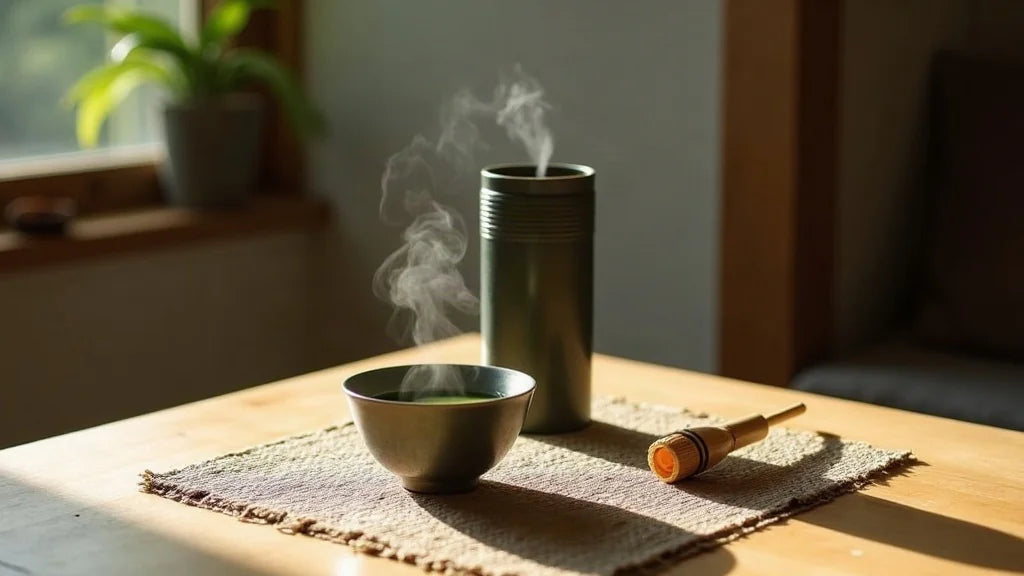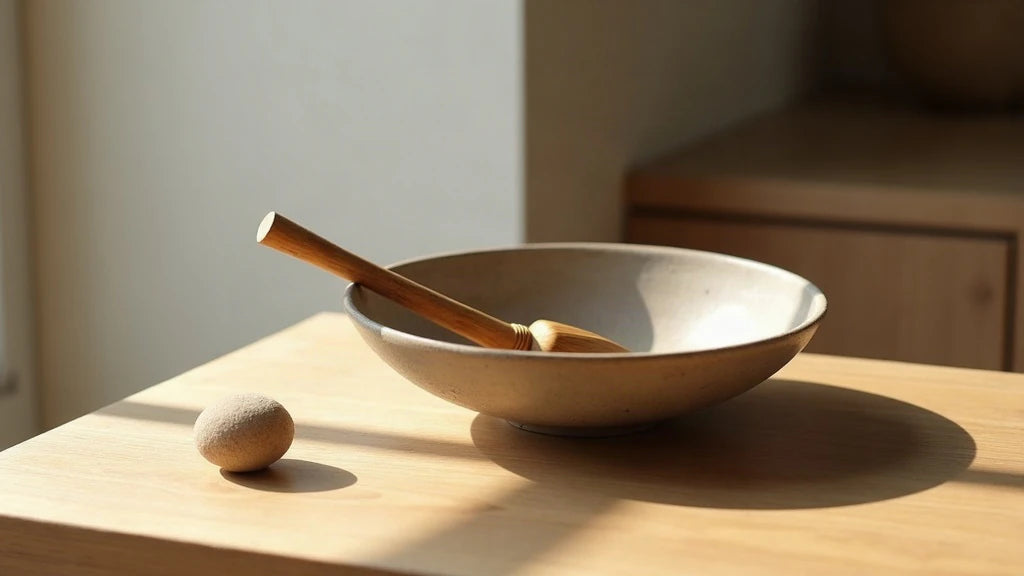

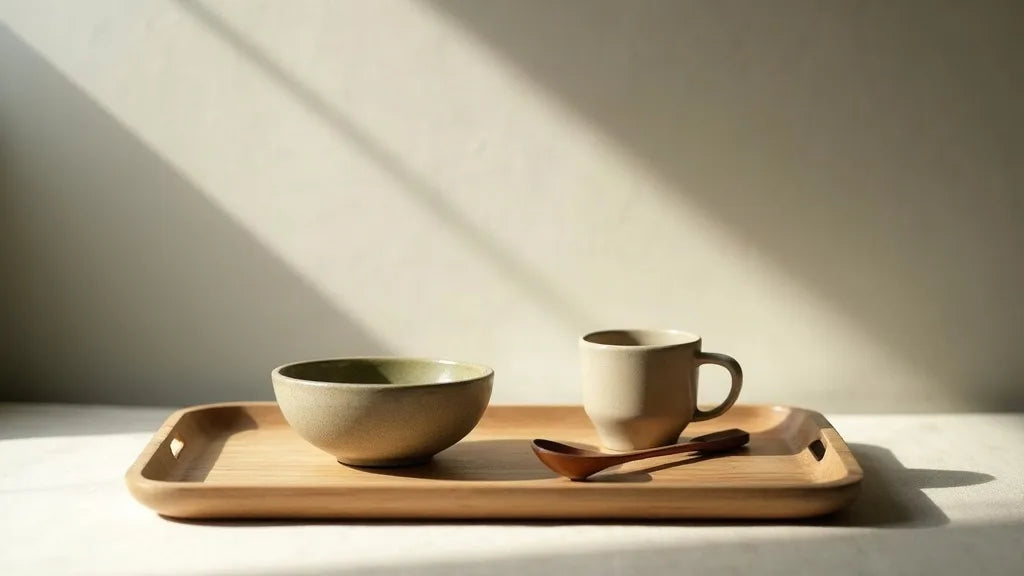
The kitchen counter at seven in the morning, pale light, and a tray that already looks like a small still life. That is the point of learning how to style a matcha set on a japandi tray: it should hold up before and after you drink. Place the matcha bowl (chawan) slightly off-centre on the tray, then set the chasen whisk and chashaku scoop in a loose triangle around it, with the cup as the third point, and leave at least a third of the tray empty. That negative space is what makes the arrangement read as calm rather than cluttered. Keep the palette to three materials (matte clay, pale wood or rattan, one textile) and three heights, and the tray stays beautiful even after you actually use it.
In short:
- Arrange bowl, whisk, scoop and cup as a triangle, never a straight line, with a third of the tray left empty.
- Limit yourself to three materials and three heights: matte clay, light wood or rattan, and one soft textile.
- Build the tray in five moves: anchor, triangle, height, texture, one living element, then stop.
- Everything on the tray should be usable daily; anything purely decorative is the first thing to remove.
Where does each piece go on a japandi matcha tray?
Start with the pieces you actually use, in the order you reach for them. A full set means four objects: the bowl, the bamboo whisk, the bamboo scoop, and a cup or small carafe. Four objects on one surface is exactly the number where alignment starts to look like a shop display, so placement matters more than the objects themselves.
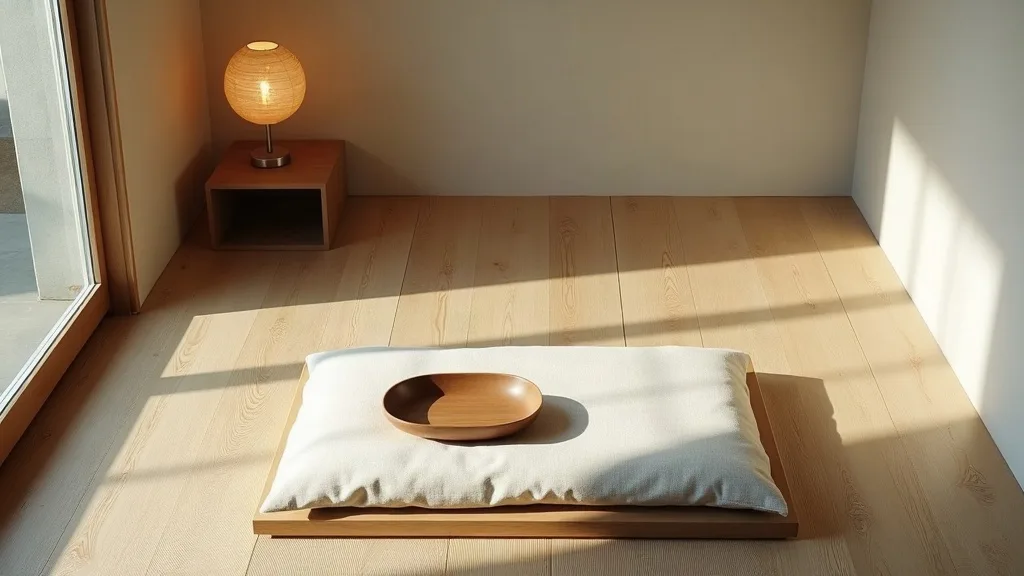
The matcha bowl as the anchor point, set off-centre
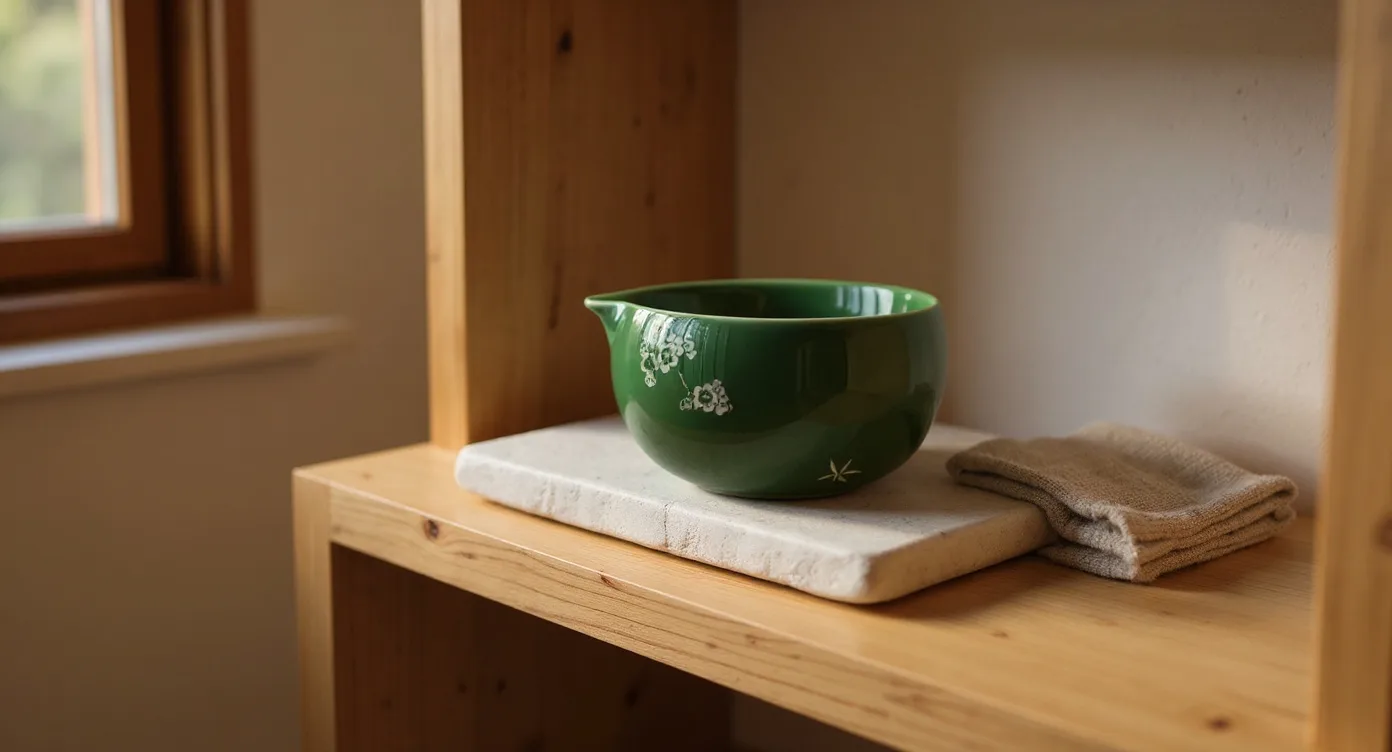
The chawan matcha bowl is the heaviest visual mass on the tray, so it becomes the anchor. Set it off-centre, roughly a third in from one edge, not dead middle. Leave 2 to 3 cm between the bowl and the tray rim so the eye reads breathing room, not a tight fit. If daylight comes from one side, turn the bowl so its most irregular glaze run faces the light; matte surfaces show their pores best in raking light.
Chasen and chashaku: the triangle that stops the clutter
Place the chasen bamboo whisk upright, tines up, ideally on its ceramic holder, behind and to one side of the bowl. Lay the chashaku scoop on a slight diagonal in front, its curved tip pointing towards the bowl rather than at the viewer. The cup takes the third point, opposite the whisk. Bowl, whisk, cup should form an uneven triangle. The most common mistake is lining all four pieces up facing the viewer. It reads flat, and the first time you pick something up the whole row collapses.
How much empty tray to leave around the set
One third empty is the working rule. On a 30 by 20 cm rectangular tray, that means keeping one short end clear, which also gives you somewhere to set a warm bowl down after whisking. This is negative space, the intentional emptiness that lets the eye rest. If you cannot see the tray surface between two objects, the tray is full, whatever the object count says.
Which tray suits a matcha set: rattan, wood or stone?
Any tray works if it fits the set without the pieces touching. A complete set needs about 28 to 32 cm of usable length, or 30 cm across if the tray is round, because a chawan alone measures 11 to 13 cm wide.
| Tray | Best shape | Useful size | Care | Japandi effect |
|---|---|---|---|---|
| Rattan or bamboo | Round | 30 to 35 cm diameter | Dry cloth, keep away from steam | Light, woven, warm; softens a hard counter |
| Pale wood (oak, ash) | Rectangular | 30 x 20 cm minimum | Wipe dry, oil lightly twice a year | Grain against matte glaze; the calmest pairing |
| Stone or lacquer | Rectangular or square | 28 x 28 cm | Damp cloth, no abrasives | Dark, still, reflective; suits low light corners |
Rattan and bamboo trays for warmth and lightness
A rattan tray brings visible weave, which counts as one of your three textures on its own. Keep the ceramics simple in return: a plain bowl, no pattern. Rattan and steam are a poor match over time, so slide a linen cloth under the bowl when you whisk.
Pale wood trays with a matcha bowl in matte clay
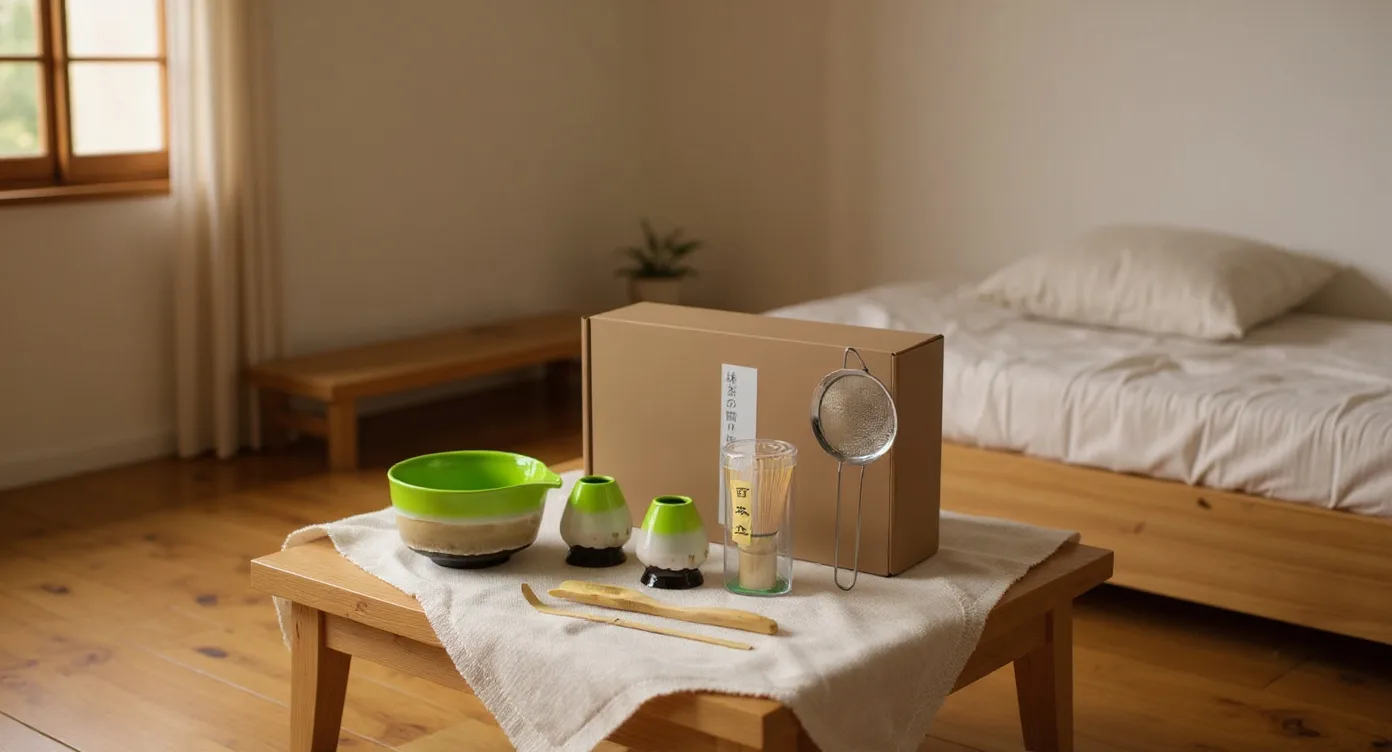
This is the pairing I return to most. Light oak wood has a straight, quiet grain that reads as a surface rather than a pattern, and a matte glaze absorbs light instead of bouncing it back. A complete set makes the triangle easy to see in practice: I often use a matte ceramic matcha set when I stage a kitchen counter, because the bowl, whisk and scoop already share one tone and you only have to solve the placement.

Stone and lacquer trays for a darker, quieter corner
In a north facing reading nook, pale wood can look washed out. A stone or lacquer tray holds the corner down and makes an oat coloured bowl glow slightly. Keep the arrangement even sparer here: bowl, whisk, cup, nothing else.
Building the matcha tray in five simple moves
Five gestures, in order, then stop. The discipline is in the stopping. Each move adds one thing, and adding a sixth is where most trays tip from composed into busy.
Move 1-2: anchor the bowl, draw the triangle
Move one: set the bowl off-centre and turn it until the glaze variation faces the light. Move two: place the whisk upright behind it and the cup opposite, then lay the scoop on the diagonal. Nothing should touch. I like keeping a single matcha green tea bowl in a warm clay body as the year round anchor.
Move 3-4: add one height and one texture
Move three is height. You want three levels: the bowl low at 7 to 8 cm, the cup intermediate, the whisk vertical at around 10 cm on its holder. Stagger them and the tray gains depth instantly. Move four is texture, and one is enough. A folded linen tea cloth under one corner does the work, its slubby weave against smooth clay.
Move 5: the single living element
Move five: one living thing. A single stem in a narrow vessel, a short branch, a small dish of moss. One, not a bouquet. It should sit at the outer edge of the triangle, not inside it, so it never blocks your hand reaching for the whisk. When the stem dries out, replace it or leave the spot empty for a week.
TOP 50 Matcha Recipes (ebook)
Once your tray is built, you will want a reason to use it every morning , I keep this recipe book nearby for the days when plain matcha feels too familiar. Fifty ways to make the ritual worth repeating.
View product →What colors work with matcha green in a japandi palette?
The matcha itself is the accent, so nothing else needs to be. Whisked usucha is a bright, slightly cool green, and it appears for perhaps ten minutes at a time. Build the tray for the other twenty three hours: neutral, warm, low contrast, with the green landing like a small event.

Off-white, oat and warm grey around the chawan
Off-white, oat and warm grey are the safest and the most flattering. A warm clay body with visible speckle sits beautifully under cool green because the undertones oppose each other gently. Matte glaze ceramic in these tones also hides matcha staining better than a pure white gloss.
Charcoal and black clay for contrast without heaviness
A charcoal or black clay bowl gives the green real depth; the foam reads almost luminous against a dark interior glaze. Keep the tray pale in that case so the composition does not go heavy. Black bowl, pale wood, off-white linen: three values, three materials, done.
Colors to avoid next to a matcha bowl
High gloss anything, bright blue glazes, and busy florals or dense patterns all compete with the green. Metallic trims bounce light and break the matte calm the rest of the tray is built on.
Keeping the matcha tray usable (and tidy) every day
A tray that lives on a counter has to survive water, steam and daily hands. Most of the maintenance is one gesture repeated.
Drying the chasen and protecting the tray surface
Rinse the whisk in warm water only, never soap, shake it gently and set it tines up on its holder to dry fully in open air. Wipe the bowl and dry it before it goes back on wood. A linen cloth or a small saucer under the bowl catches condensation, and a light oiling of a wooden tray twice a year keeps the grain from going grey and thirsty.
Where to place the tray: kitchen counter, shelf or reading nook
Place the tray where your hand already goes, not where the composition looks best from the doorway. Near the kettle, out of the splash zone of the sink, with 15 cm of clear counter around it. On an open shelf, keep it at chest height so you see the arrangement in plan, not in silhouette. In a reading nook, a low side table works if the tray does not sit in the walking line.
The weekly edit: remove one thing
Once a week, look at the tray and remove whatever you did not touch. A second cup, a spare tin, a decorative pebble. This is fewer, better choices applied to thirty centimetres of surface. The tray gets emptier for a while, then settles into the four or five pieces that genuinely earn their place.
Matcha tray styling questions, answered
Short answers to the questions that come up most often when I stage a tea corner.
What is the 30/20/10 rule for matcha?
There is no single agreed definition, and it is not part of classical Japanese tea practice, so treat it as online shorthand rather than a rule. What is reliable: about 2 g of matcha, 60 to 70 ml of water at roughly 70 to 80 °C, whisked briskly in a W motion until foam forms.
What color goes best with matcha green?
Off-white, oat and warm grey, with charcoal or black clay when you want the green to look deeper. Warm clay undertones flatter the cool green more than cool blue-grey does. Skip gloss, metallics and dense patterns nearby.
How do you properly use a matcha set?
Warm the bowl with hot water and pour it out, scoop one to two chashaku of sifted matcha into the dry bowl, add a splash of water at 70 to 80 °C and work it to a smooth paste. Add the rest of the water and whisk briskly with the wrist, tines just off the base, in a W or M motion until a fine foam rises. Drink from the bowl, or pour into a cup if you prefer.
What size tray do I need for a full matcha set?
Around 30 by 20 cm rectangular, or 30 cm across if round, as a working minimum. That allows the bowl, whisk holder, scoop and cup to sit without touching, plus the third of empty surface that keeps the arrangement calm. If your tray is smaller, leave the cup off and drink straight from the bowl.
Why should you not drink matcha on an empty stomach?
Matcha contains caffeine and tannins, and some people simply find that combination uncomfortable before eating. Others drink it first thing with no trouble at all. If you have a specific health concern, ask a professional rather than a decor blog.
If you are assembling your first tray, the bowls, whisks and complete sets in our Matcha Set collection are chosen for matte surfaces and honest clay bodies, the two things that make a japandi tray easy to compose. Start with the bowl, add the rest slowly.
Explore the Matcha Set collection
Browse the Matcha Set collection to find the bowl, chasen and scoop that will sit well together on your tray.
Browse the collection →