

How to light a tea corner or matcha station without glare
The light you want is diffused, warm and pointed down at the surface where your hands work. Diffused means the bulb is hidden behind something that spreads the light: paper, frosted glass, linen, a thick ceramic shade. Warm means low on the Kelvin scale, closer to candlelight than to daylight. Pointed down means the fixture sits above the counter, not in the middle of the ceiling, because a central ceiling light throws light from behind you and across the whole room at once.
Why a tea corner needs one pool of light, not a lit room
A tea ritual is close work in a small area. Your eyes are focused on a 40 cm square: the bowl, the sifter, the scoop, the surface of the water. When the whole room is evenly bright, that square has no more visual weight than the fridge behind it, and the eye keeps wandering. One pool of light does the opposite. It draws a border around the work, and everything outside that border recedes without being hidden. This is ordinary task lighting logic, the same reason a desk gets its own lamp, applied to a surface where the task happens to be whisking tea. The practical effect is that you stop scanning the room and start watching your hands, which is most of what a tea corner is for.
Where the glare actually comes from on a matcha station
Glare on a tea station almost never comes from the counter. It comes from three curved, wet or polished things. The first is the glaze on the chawan, your tea bowl: a glossy interior is effectively a concave mirror, and a bare bulb above it lands as a white dot right where you need to read the foam. The second is the water, in the kettle's open mouth or already in the bowl, which reflects whatever is above it at close to full brightness. The third is a lacquered tray, the traditional choice and the most reflective surface in the whole scene. Change the source from a bare bulb to a diffused shade and all three calm down at once, because a wide soft source has no hot point to mirror. That is why the fixture matters more than the wattage.
There is one more source people forget: the wall behind the station. Pale gloss paint or a tiled splashback will bounce the pendant's light straight back into your eyes at counter height. Lime-washed walls, matte paint or unpolished stone absorb and soften that bounce instead. If you cannot change the wall, move the fixture 10 cm forward so the pool lands on the front half of the counter rather than against the back surface. Small moves like this do more for comfort than swapping bulbs.
The soft-shadow rule behind Japanese tea corner lighting
In the machiya townhouses of Kyoto, the rooms I liked best in the early morning were lit almost entirely sideways. Light came in low through paper screens, crossed the tatami, and died out before it reached the back wall. Objects in that light had one soft shadow each, falling in the same direction, with no second shadow crossing the first. That single-direction, soft-edged shadow is the whole rule, and it is easy to copy: one main source for the station, placed above and slightly in front of the work, and nothing competing with it from the other side. Two sources of equal strength give every object a double shadow and the corner starts to look like a shop display. A diffused pendant light is the default answer for a fixed corner precisely because it does this naturally. The piece I reach for most often in my own work is a wabi sabi style pendant light, because the shade hides the source completely and the shadow it drops has no hard edge anywhere.
Pendant light or table lamp over a matcha station?
The choice comes down to two questions, and you can answer both in a minute. Does the station stay in one place? And is there already a ceiling point, or at least a hook and a route for the cable, above it? Two yes answers mean a pendant. Any no means a lamp, and a lamp is not a compromise here: it does the same job from a different angle.

A pendant light for a fixed tea corner on a counter
A fixed corner on a kitchen counter or a dedicated sideboard is the case a pendant was made for. It frees the entire surface, which matters more than it sounds: a tea station needs room for a bowl, a kettle, a tray and your forearms, and a lamp base eats the best part of that. It also puts the source directly above the work, so the shadow falls under your hands instead of across them. The constraint is the ceiling. Below about 240 cm, a pendant hung at the right clearance starts to crowd the head of anyone standing at the counter, and you will keep ducking. Measure before you buy, not after.
A table or floor lamp for a matcha station that moves
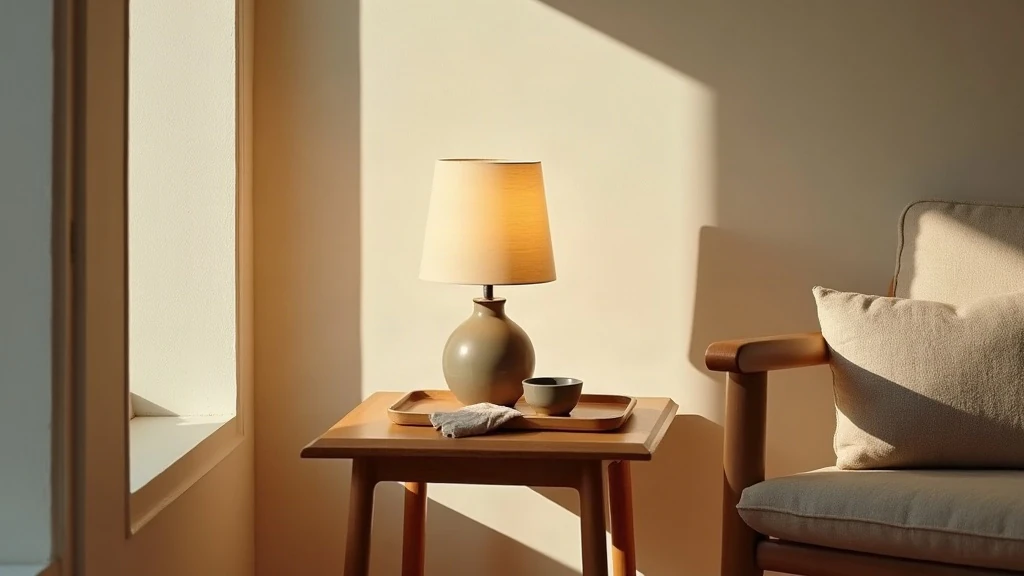
Plenty of matcha stations are not really stations. The tools live in a cupboard, the tray comes out, and tea happens wherever there is room that morning. Wiring a pendant for a scene that relocates is wasted work. A small table lamp with a paper or linen shade travels with the tray and sets the same pool wherever it lands. Accept the trade: side light rakes across the surface and makes longer shadows, so place the lamp forward and to one side of your working hand rather than directly behind the bowl. A floor lamp with a head that arches over the counter is the third option, and the quiet winner when there is no ceiling point but there is floor to spare.
Tea corner on a shelf or island: which fixture wins
A shelf changes the geometry, because a shelf has a ceiling of its own: the shelf above it. If you have 40 cm or more of clearance, a tiny lamp or a hidden strip under the upper shelf lights the surface well and no pendant is needed. Below that, there is not enough air for a shade and you are better off lighting the shelf from a nearby floor lamp. An island is the opposite case and the easiest of all: full clearance, no wall to bounce light back, and a pendant reads as intentional there rather than improvised. On an island, keep the fixture over the half of the surface where you actually work, not over the geometric centre, which is usually empty.
Warm bulbs and dimming for a calm tea corner
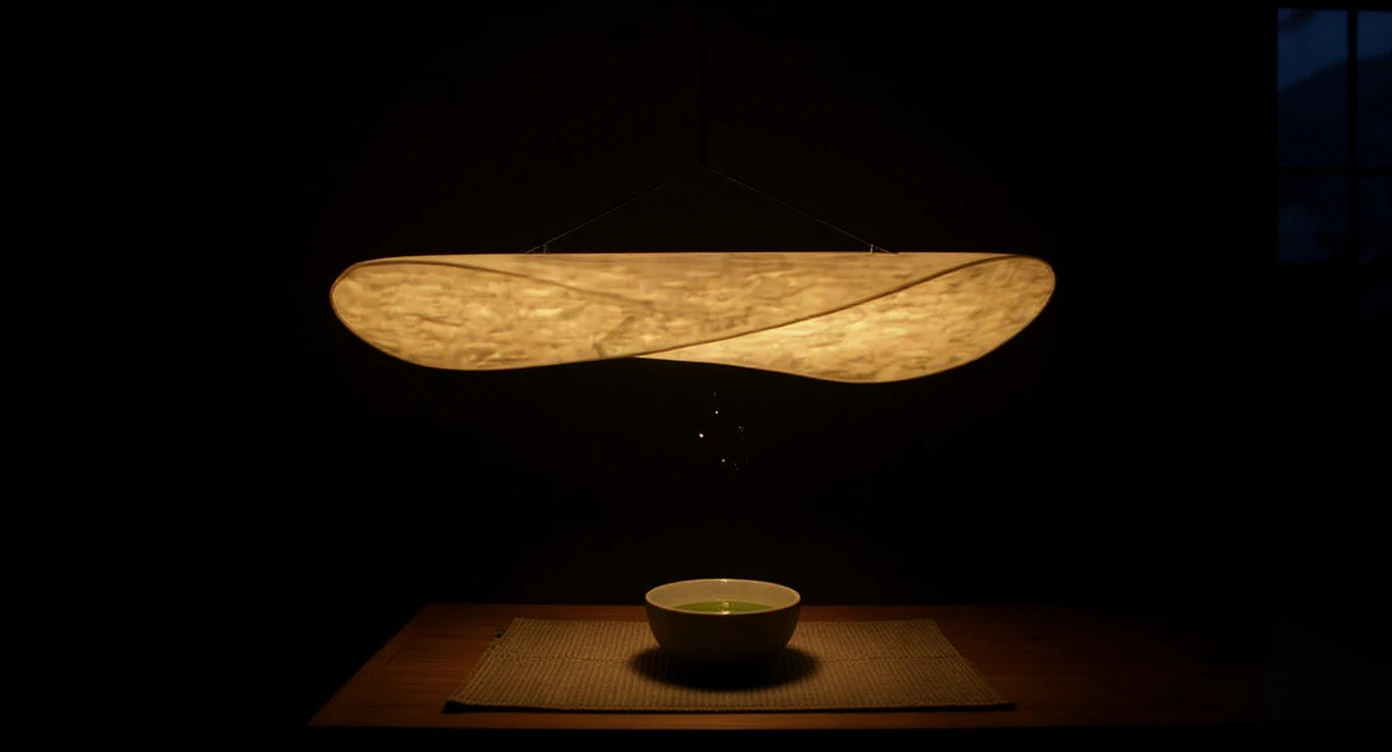
The bulb decides more than the fixture does. Three numbers matter: colour temperature in Kelvin, output in lumens, and colour rendering index, written CRI, which measures how faithfully a light source shows colour compared to daylight. Get those three right and a modest fixture performs well. Get them wrong and the best shade in the world is lighting a hospital corridor.
2200K to 2700K: the bulb temperature a tea corner wants
Color temperature describes whether light leans orange or blue, measured in Kelvin, where lower numbers are warmer. For a tea corner, 2200K to 2700K is the band to stay inside. At 2700K you get standard warm white 2700K light, close to an old incandescent bulb, and clay, oak and linen all look like themselves. At 2200K the light goes closer to candle, which suits an evening corner and flatters unglazed ceramic. Push past 3000K and two things go wrong. Matcha's green shifts toward grey-khaki because cooler light underplays the warm half of the spectrum, and the grain of ceramic flattens out, since the slight yellow in warm light is what reveals texture on a pale glaze. CRI above 90 fixes the rest: below that, cheap LEDs render greens and earth tones poorly no matter what the Kelvin number says. Most of my own corners run a warm, high-CRI E27 bulb I keep restocking, simply because the E27 socket is the standard screw fitting on nearly every pendant and lamp sold in Europe, so one bulb choice covers the whole house.
How many lumens over a matcha station is enough
Lumens measure total light output, and tea corners need far fewer than people assume. Aim for 200–400 lumens reaching the surface. That is roughly a 25–40 watt incandescent equivalent, or a 3–5 watt LED. At 200 lumens you can see the foam, the sieve and the colour of the powder clearly, and the corner still reads as a pool rather than a workspace. Above about 600 lumens the pool loses its edge, the surrounding room looks dark by contrast, and you get exactly the flat brightness you were avoiding. One caveat on the arithmetic: a bulb's rated lumens are not what lands on the counter. A dense paper or ceramic shade can absorb a third of it, so a 500 lumen bulb behind a thick shade may deliver 330 to the surface. Buy slightly brighter than the target when the shade is opaque, and dim it down.
Dimmable bulbs and the difference between morning and evening tea
A dimmer switch is the single upgrade I recommend most often for a tea corner, and it costs less than the fixture. Morning and evening ask for different light. At seven in the morning there is daylight in the room, and the pendant only needs to fill the shadow your body casts over the counter, so you run it low. At nine at night the pendant is the only source, and you still want it low, but for a different reason: your eyes have adapted, and what felt gentle at breakfast feels harsh in the dark. Without a dimmer you end up choosing one setting that is wrong twice a day. Check two things before buying: that the bulb is marked dimmable, since many LEDs are not and will flicker or buzz, and that the dimmer is rated for LED loads, because older models designed for incandescent bulbs misbehave at low wattages. If rewiring a switch is out of reach, an inline cord dimmer on a plug-in lamp does the same job.
How high to hang a pendant light above a matcha station
This is the measurement that makes or breaks the corner, and it is easy to get right. Hang the bottom of the shade 70–80 cm above the worktop. On a standard 90 cm counter, that puts the shade's lower edge at roughly 160–170 cm from the floor. Those two numbers are the same fact stated from different reference points, and the counter is the one to measure from.

70–80 cm above the worktop: the whisking clearance
The lower limit exists because of the chasen whisk. Whisking matcha is a vertical wrist motion, and your hand rises 20 to 25 cm above the bowl at the top of the stroke, with the bowl itself already 8 to 10 cm tall. Below 70 cm you will knock the shade, or hover to avoid it, which ruins the motion. The upper limit exists because light falls off fast with distance: past 80 cm the pool spreads wide and weak, and the defined circle you were building turns into general room light. If the corner is used standing, 150–165 cm from the floor is the usable range for the shade's lower edge on counters of varying height. If the corner lives at a dining table where you sit, drop the shade lower, to about 70 cm above the tabletop, which puts its lower edge just below the eye line of a seated person. That is deliberate: a shade below eye level blocks the source from view entirely.
Hanging a pendant light you look under, not into
The test takes ten seconds. Stand where you will actually work, at your real height, and look at the fixture. If you can see the bulb or the bright inner surface of the shade, it is hung too high or the shade is too shallow. A phone works better than your eyes here: open the front camera, hold the phone at the position your face occupies while whisking, and look at the screen. A visible bright source means glare, every time. Repeat the test seated if the corner doubles as a table. You are aiming for a fixture whose light you see on the counter but whose source you never see directly, which is the entire reason a diffused shade or a deep opaque one outperforms a glass globe in this spot.
Shade width versus the depth of your tea corner
Width is the measurement people skip. A shade should span roughly one third to one half of the counter width it serves. On a 60 cm tea station, that means a shade of about 20 to 30 cm across. Narrower and the pool is a spotlight that lights the bowl but not the tray beside it. Wider and the fixture dominates a small corner visually, and in a kitchen it starts to read as a dining pendant in the wrong place. Depth matters too: on a shallow 35 cm counter, a wide shade will sit close to the wall and bounce light back at you, so centre it 18 to 20 cm out from the wall rather than splitting the depth evenly. Washi paper shade options behave differently from ceramic here, because paper glows slightly across its whole surface and so gives a wider, softer pool from the same diameter.
TOP 50 Matcha Recipes (ebook)
Once the corner is lit, I want a reason to stand in it every morning , this is the file I open when I run out of ideas beyond a plain bowl of usucha. Fifty recipes, from the daily whisk to iced and baked versions.
View product →What belongs on a lit matcha station, and where
Lighting the corner is half the work. The other half is deciding what the light is allowed to show. A pool of light is an editor: whatever sits inside it reads as important, and whatever sits outside recedes. Use that deliberately instead of lighting everything you own.
Placing the chawan and whisk inside the pool of light
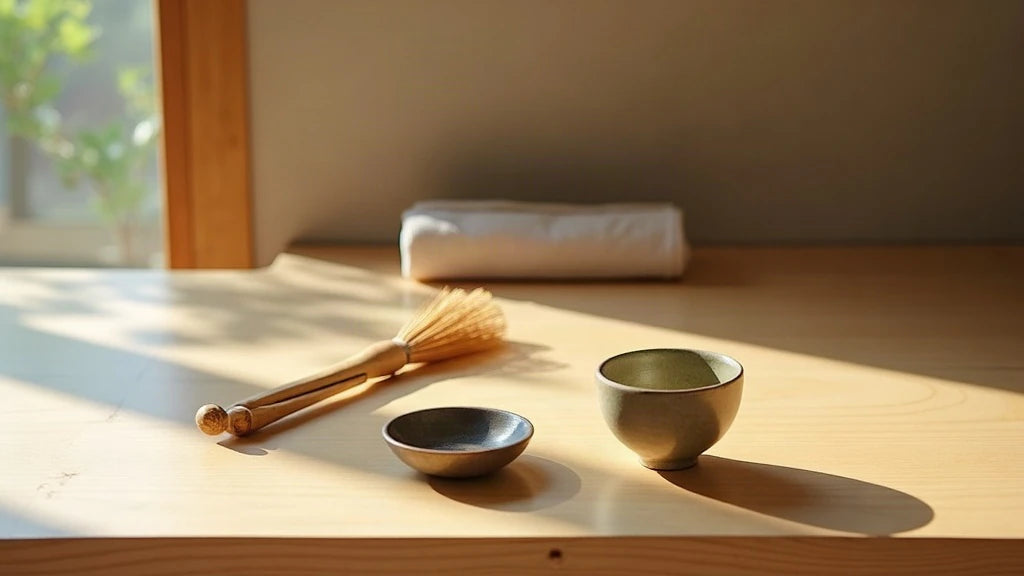
Four things belong in the bright circle: the chawan, the bowl you whisk in; the chasen, the bamboo whisk; the chashaku, the bamboo scoop; and the tea caddy holding the powder. These are the objects your hands touch in sequence, and they are also the ones worth looking at, because bamboo and unglazed clay both show their texture best in low warm light. Everything else goes to the edge or behind: kettle at the back of the pool where you can still see the water level, cloths folded out of the circle, spare cups on a shelf. The set I keep on my own station is a simple matcha whisk set, chosen because the bamboo tines catch warm light along their length and the stand keeps the whisk upright inside the pool rather than lying flat in shadow.

Where you place the pool matters as much as what goes in it. Put the circle slightly forward on the counter, so the brightest part lands where the bowl sits during whisking rather than against the back wall. Then work out your dominant hand: light coming from the same side as your working arm means your own arm casts the shadow onto the bowl. Shifting the fixture 10 cm to the opposite side removes the problem without changing anything else.
Keeping the tea corner surface matte so the light stays soft
Soft light needs matte surfaces to stay soft, because a gloss finish returns the fixture to you as a hot reflection. Three swaps do most of the work. Replace a lacquered or varnished tray with unfinished wood, raw clay or matte stone, and the pool spreads evenly across it. Put a piece of washed linen under the bowl, which both absorbs reflection and stops ceramic sliding on wood. Avoid polished stone directly under the beam: travertin with its open pores behaves beautifully, while a honed-to-gloss marble offcut will mirror the shade all day. If your counter is already glossy, a linen runner or a matte wooden board under the station solves it in one move, no renovation required.
One shelf, one tray: the minimum a matcha station needs
Sixty centimetres of linear surface is enough for a complete station, divided into three zones. Zone one, the left 20 cm, is preparation: caddy, scoop, small sieve. Zone two, the middle 20 cm, is the lit centre: bowl and whisk stand, directly under the pool. Zone three, the right 20 cm, is landing and storage: kettle at the back, finished cup at the front, cloth folded underneath. If the station is used left-handed, mirror the whole thing. One shelf above for cups, one tray to define the station's footprint, and that is the complete object list. The empty counter around those 60 cm is not wasted space; that negative space is what makes the lit zone read as a station at all. Fewer, better choices earn their place here, because every extra object you add to the pool takes attention away from the three or four that matter.
FAQ
The questions that circle back most often narrow down to light height, bulb colour, and whether a dimmer earns its place. Below are the details, measured and straightforward, for each one you will likely need.
How do you set up a matcha station at home?
Pick 60 cm of surface near water, and split it into three zones: preparation on one side, bowl and whisk in the lit centre, kettle and storage on the other. Add one light source above or beside the centre zone, at 200–400 lumens and 2200–2700K. Keep the surface matte, add a shelf above for cups, and stop there.
What is the 30/20/10 rule for matcha?
It is a preparation ratio that circulates online, not a lighting rule, and it is worth being clear about that. Versions of it refer to proportions of matcha, water and milk in grams and millilitres for a latte. It has nothing to do with fixtures, lumens or hanging heights, so do not try to apply it to your lighting plan.
How high should a light hang over a tea corner?
Hang the bottom of the shade 70–80 cm above the worktop, which is about 150–165 cm from the floor on a standard counter. If the corner lives at a dining table where you sit, use 70 cm above the tabletop so the shade sits just below a seated eye line. Check it with your phone's front camera: if you can see the bulb, it is too high.
What color temperature is best for a matcha station?
Between 2200K and 2700K, with a CRI above 90. That band keeps matcha's green true and lets the texture of clay and bamboo show. Above 3000K the green reads grey-khaki and pale ceramic loses its grain.
Do I need a dimmer for a tea corner light?
You do not need one, but it is the cheapest real improvement available. Morning tea with daylight in the room and evening tea in the dark want different levels, and a dimmer lets one fixture serve both. Confirm the bulb is marked dimmable and the dimmer is rated for LED loads, or use an inline cord dimmer on a plug-in lamp.
If you are building a fixed corner and have the ceiling height for it, the wabi sabi pendant light collection is where I would start looking for a shade that hides its source. Take your counter width with you, and work back from the 70–80 cm clearance.
Explore the Wabi Sabi Pendant Light collection
Browse the pendant lights we hang over counters and tea corners: diffused shades, warm light, visible materials.
Browse the collection →