
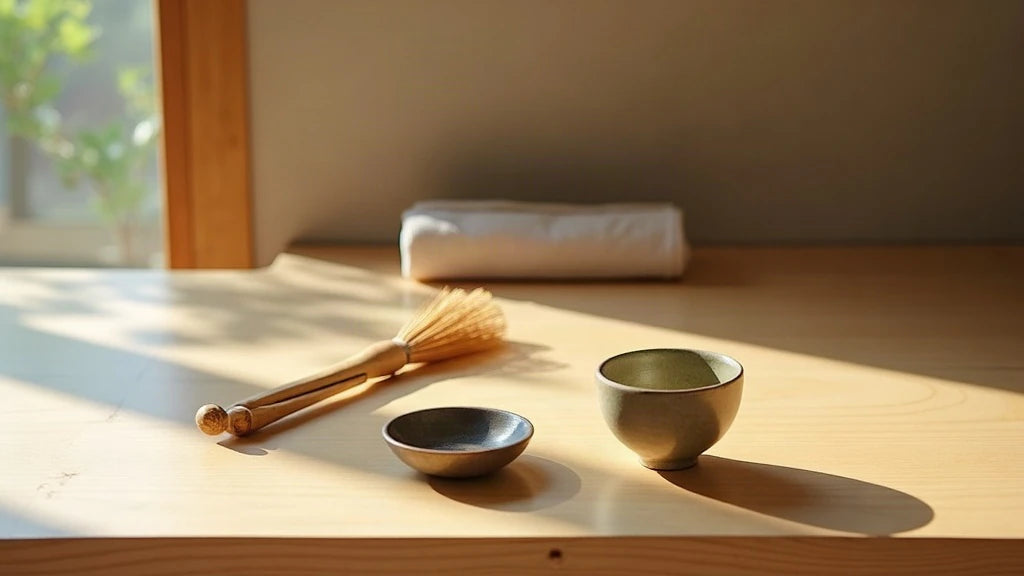
The first bowl I ever whisked split into a grey puddle with lumps floating on top. The bamboo whisk was fine. I had skipped the sifter. A matcha set includes four essentials: a chawan (wide ceramic bowl), a chasen (bamboo whisk), a chashaku (bamboo scoop) and a sifter, with most complete sets adding a ceramic whisk holder to dry the chasen in shape. The bowl gives the whisk room to move, the whisk builds the foam, the scoop measures roughly one gram per pass, and the sifter breaks the clumps that cause a gritty bowl. Almost no set includes the matcha powder itself, so that is the first thing to check before you buy.
Key points
- Four pieces make a set usable: chawan bowl, chasen whisk, chashaku scoop and sifter.
- A whisk holder is the piece most budget sets drop, and it is what keeps the chasen from splaying.
- Matcha powder is almost never included, so budget for it separately.
- Check the whisk first: thin, sparse or fused prongs mean a weak foam no matter how pretty the bowl is.
What is included in a matcha set: the four essentials
Lay a set out on a tray and the logic becomes obvious. Each piece solves one problem, and the four together solve the whole bowl. Nothing in the group is decorative. If a piece feels like filler, it probably is.
The chawan, the matcha bowl you whisk in
The chawan is the wide ceramic bowl you whisk in, and its width is the whole point. You want roughly 11 to 13 cm across the mouth and a floor that curves rather than meets the wall at a sharp angle. That curve lets the prongs sweep without catching, and the width gives your wrist somewhere to go.
A mug will not do this. The walls are too close, the whisk hits them, and the foam never forms. I have watched people blame their powder for a problem that was only ever the shape of the vessel.
Look at the inside of a glazed ceramic bowl before you commit. The glaze should run even across the floor, with no bare patch where the clay shows through. Small pooling at the edges is normal and often beautiful. A rough unglazed interior will hold matcha residue and stain within a month.
Set it on a flat surface too. The foot ring should sit without a wobble. A bowl that rocks while you whisk fast is a bowl you will stop using.
The chasen and chashaku, the bamboo tools
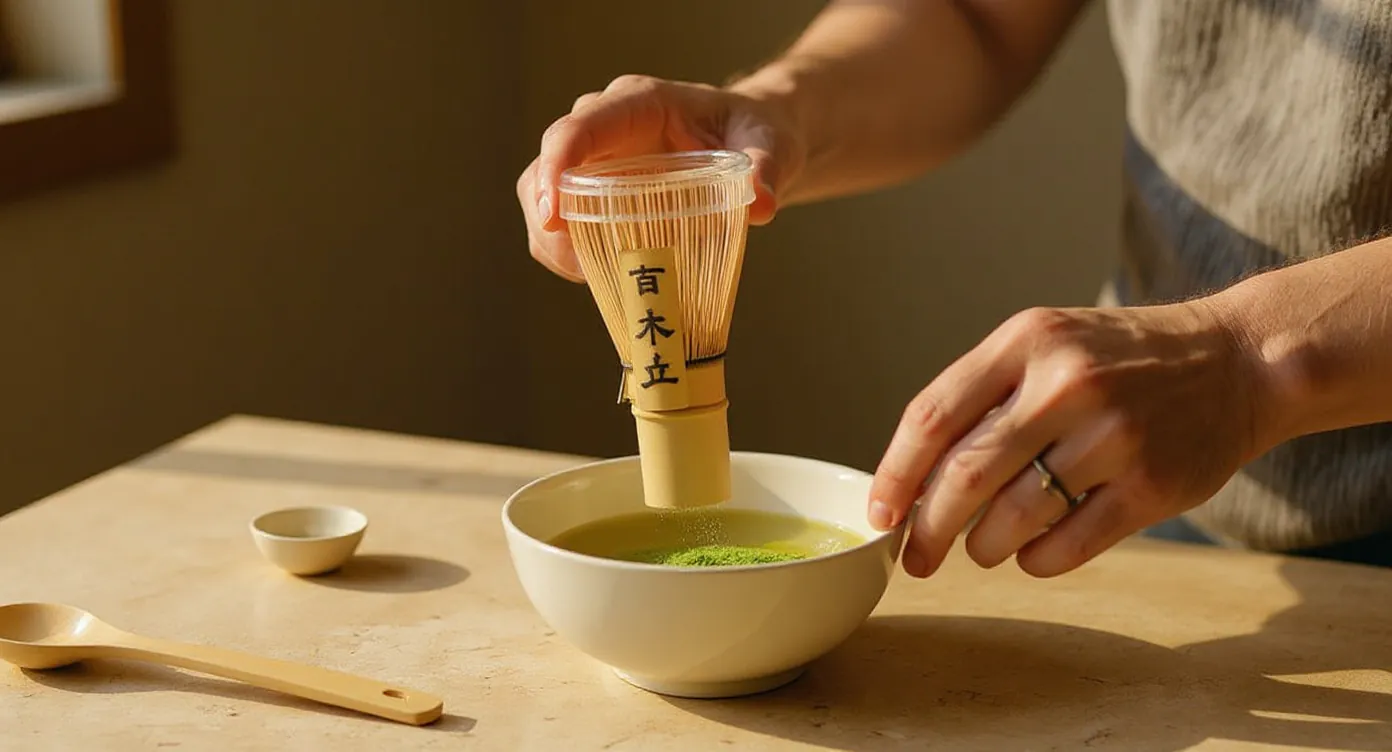
The chasen bamboo whisk is cut from a single piece of bamboo and split by hand into fine prongs. Count them if you can. A workable everyday whisk sits somewhere around 70 to 100 prongs, and more prongs generally means a finer, faster foam. Below about 50, you are working much harder for a thinner result.
The prongs should curl slightly inward at the tips. That inward curl is what traps air. Straight, stiff prongs push the water around instead of lifting it.
The chashaku bamboo scoop is the narrow curved spoon with a bend near one end. One level scoop holds roughly one gram of powder, which is why recipes are written in scoops rather than grams. Two scoops is a standard bowl of thin tea.
It exists for a reason beyond measuring. Bamboo does not react with matcha, it does not hold moisture, and the shallow curve lets you tap powder off cleanly into the sifter. A metal teaspoon works, but it scoops inconsistently and the volume is hard to repeat.
The sifter in a matcha set, and why it matters
The matcha sifter is a small fine mesh ring, sometimes with a tiny spatula. Matcha is ground to a powder fine enough to clump against itself in the tin, and those clumps do not dissolve in water. They break into grit on your tongue at the bottom of the bowl.
Pushing the powder through the mesh takes about ten seconds and changes the texture completely. It is the cheapest piece in most sets and the one that makes the biggest difference to the first bowl you make.
The fifth piece, when a set includes it, is the kusenaoshi whisk holder: a small ceramic dome you rest the damp chasen over to dry. The prongs keep their curved shape instead of drying flat and splayed. Budget sets drop it first because it is ceramic and adds weight to shipping, but it directly decides how long your whisk lasts.
When people ask me what a finished set looks like in practice, I point them at the matcha whisk set I keep on my own counter, because it has the four pieces plus the holder and I never had to go hunting for the missing one.

How a matcha set works, from sifting to whisking
The order matters more than the technique. Each piece hands off to the next, and skipping a step shows up in the bowl. Three or four bowls in, your hands know the sequence and it takes under two minutes.
Sifting and scooping with a matcha set
Start dry. Rest the sifter over the empty chawan, add two chashaku of powder, and press it through the mesh with the back of the scoop or the little spatula. The powder lands in a soft heap, loose and bright green.
Warm the bowl first if you have a minute. A splash of hot water, swirled and poured out, dried with a cloth. A cold bowl pulls heat from your water and the foam suffers for it.
Two scoops gives you about two grams, which is usucha thin tea: the everyday bowl, light and frothy. Four scoops with a third of the water gives koicha thick tea, which you sip slowly and do not whisk to a foam at all. Start with usucha. Koicha needs good powder to be worth it.
Whisking in the chawan: the W-shaped motion
Pour 60 to 70 ml of water at around 80 °C over the powder. Not boiling. Boiling water scorches matcha and pulls out a flat bitterness you cannot whisk away.
Then whisk in a brisk W or M shape across the surface, fast, from the wrist. Not in circles. Circles spin the liquid without breaking the surface. The W motion cuts back and forth and drags air in.
Hold the whisk light and keep the prongs just off the floor of the bowl. Pressing down grinds the tips against the ceramic and breaks them. Fifteen to twenty seconds is usually enough. Finish by lifting the chasen slowly through the centre to settle the largest bubbles.
Your first bowl with a matcha set, step by step
- Soak the chasen in warm water for two to three minutes.
- Warm the chawan, pour the water out, wipe it dry.
- Sift two chashaku of powder into the bowl.
- Add 60 to 70 ml of water at about 80 °C.
- Whisk in a fast W motion for 15 to 20 seconds, prongs just above the floor.
- Lift the whisk slowly through the middle.
- Drink from the bowl, within a minute or two, before it separates.
- Rinse the chasen in plain water and stand it on its holder.
Three things ruin a first attempt. Water straight off the boil. Pressing the whisk into the bottom. And a bowl too narrow for the prongs to move. None of them are about skill.
What a matcha set does not include (and what to add)
A matcha set is a set of tools. It is not a tasting kit. Most of the disappointment in online reviews comes from that one gap in expectation, and it is easy to close before you order.
Matcha powder is rarely in the matcha set
Assume the powder is separate unless the listing says otherwise in plain words. Tins have a short good life once opened, they need cool dark storage, and they ship under different rules than ceramics and bamboo. That is why makers leave them out.
Buy ceremonial grade matcha powder for drinking, which simply means powder from young first-harvest leaves, ground fine and intended for whisking in water rather than baking. It should be a vivid green, closer to new moss than to khaki. Dull olive powder has usually been sitting too long or came from later harvests. Culinary grade is cheaper and fine in a latte, but it turns harsh in a plain bowl.
A 30 g tin gives roughly fifteen bowls at two grams each. Start small. Matcha fades within weeks of opening, and a large tin bought for value often ends up tasting flat by the end.
Water, kettle and temperature beside your set
You need a way to hit roughly 80 °C. A variable temperature kettle is the simple answer. Without one, boil and wait five minutes with the lid off, or pour the water into a cold cup first and then into the bowl, which drops it a useful amount.
Soft or filtered water tastes noticeably better than hard tap water here. There is nothing to hide behind in a bowl of matcha. Hard water flattens the sweetness and leaves a mineral edge.
Add a small cotton or linen cloth to the tray as well. You will wipe the bowl rim, catch drips from the whisk, and dry the sifter. A dedicated cloth kept with the set stops you reaching for whatever is near the sink.
A tea cup beside the matcha bowl, for guests
A chawan is for whisking, not for serving. If someone sits with you and does not want matcha, you need something else to put in their hands. This is where a second vessel earns its place on the tray.
For that, I reach for a small ceramic tea cup and pour sencha or houjicha, because the shape holds heat properly and the two pieces look right sitting beside each other. It also means you are not whisking two bowls back to back while your own goes cold.
Complete vs incomplete matcha set: how to tell
Listings use the word set loosely. Some include five pieces, some include a bowl and a whisk, and some are a single bowl with a styled photograph. Reading the piece list rather than the title solves most of it in under a minute.

Matcha set checklist: four pieces and a holder
Run through this before you buy. Does the listing name a bowl, a whisk, a scoop and a sifter as separate items. Is a whisk holder in the photograph and also in the written list, since photos sometimes show props. Is the bowl width given, and is it over 10 cm. Is the powder mentioned, and if so, how many grams.
Two missing pieces is usually the moment to look elsewhere. A sifter and a holder bought separately often cost more than the gap between a partial set and a full one.
Signs of a weak chasen in a cheap matcha set
I handle every whisk that comes through before it goes out, and the same faults repeat. Prongs fused together in pairs, from a rushed split, which halves the effective count. Prongs that look thick and blunt rather than tapered, which means they will push water instead of aerating it. A whisk that feels bone dry and pale, which cracks on first use.
Varnished or lacquered bamboo is a clear no. Bamboo tools are left bare so they can take up and release water. A coating seals them, traps moisture underneath, and will flake into your bowl.
On the ceramic side, check three things. An even glaze inside with no bare clay on the floor. A flat, stable foot. And a rim with no sharp chips, since you drink directly from it. Colour variation between bowls from the same kiln is not a fault. It is how wood and gas firing works, and I would not want it any other way.
Weight tells you something too. A good everyday chawan has some mass in the hand without being heavy. Very light, thin-walled bowls cool fast and feel precarious when you whisk hard.
Matcha set prices, and what the money buys
Money goes into three places, and only three. The whisk, where hand-splitting and prong count separate a tool from a token. The bowl, where the clay body, the glaze and the firing decide whether it survives daily use and heat. And completeness, where the sifter and holder are included rather than sold back to you later.
What it does not buy is a better bowl of tea by itself. A mid-range complete set with fresh powder beats an expensive bowl with a stale tin every time. Spend on the whisk and the powder before the ceramics, then let the bowl be the piece you upgrade when you know what you like. That is the fewer, better choices idea in practice, and it applies here as much as to furniture.
TOP 50 Matcha Recipes (ebook)
Before I decide a set is worth it, I like knowing what it will actually make all year, so I open this recipe book: fifty ways to use the same bowl and whisk, from thin usucha to iced matcha.
View product →Living with a matcha set: your daily bowl at home
A set kept in a high cupboard becomes a once-a-month thing. A set within arm's reach becomes a ten-minute pause in the morning. The difference is logistics, not discipline.
Where to keep a matcha set between bowls
Gather the five pieces on one small tray and leave it out on the counter or a low shelf. Wood or stone, nothing precious. The tray holds the group together so you are not opening three drawers before you can start.
Keep the powder tin elsewhere, closed, away from light and the heat of the hob. Matcha oxidises in daylight and takes on smells from nearby spices. Cool, dark, sealed.
Leave space around the tray. A clear 20 cm of empty counter on either side makes the group read as intentional rather than cluttered, and that negative space is doing real work for the eye.
Sitting low with your matcha bowl
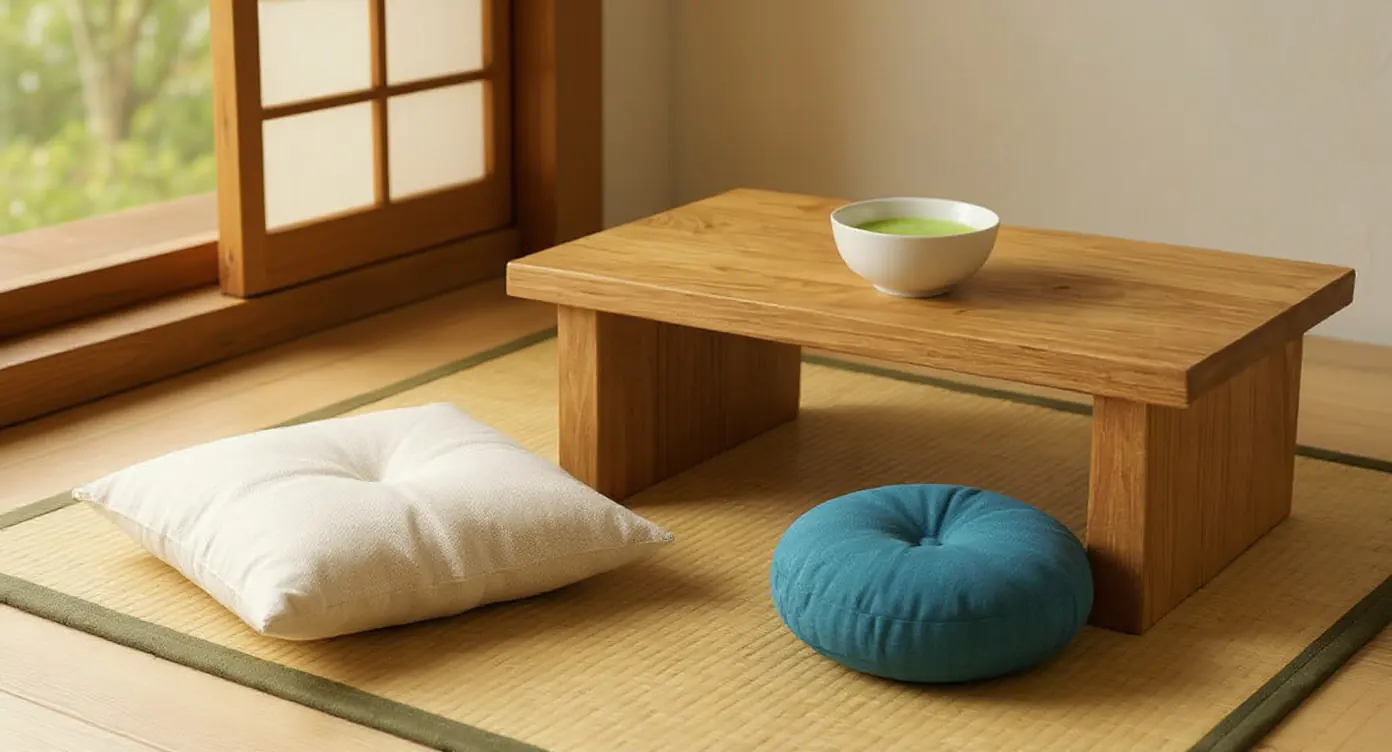
A bowl of matcha is held in two hands and drunk slowly. That reads differently sitting low than it does standing at the counter. In Kyoto I drank most of mine on tatami, at ankle height, and the posture is part of why the bowl shape makes sense: wide, warm, cradled.
If you have a corner by a window, that is enough. A low stool, the floor, a step. The whisk stand and tray can sit beside you on the floor while you drink.
When I want to sit low without the floor getting cold and hard, I use a Japanese floor cushion by the window, because it is firm enough to hold its shape through a long bowl and it tucks against the wall when I am done. Two of them turn a bare corner into a place where someone can join you.

Caring for the chasen so the set lasts
Rinse the chasen in plain warm water straight after use, swirling it in the bowl, then shake it gently. No soap, ever. Soap gets into the split bamboo, holds there, and you taste it in the next bowl.
Stand it on its holder, prongs up and over the dome, somewhere with air movement. Never leave it sitting in water or lying flat in a drawer while damp. Flat drying is what splays the prongs permanently.
The chawan is hand wash only. Warm water, a soft cloth, no abrasive side of the sponge. Dishwashers are the quickest way to craze a glaze and dull the surface, and thermal shock cracks ceramics, so no cold rinse on a hot bowl. The chashaku gets wiped dry, not washed, since soaking warps the bend.
Expect staining on light interiors over time. A faint green shadow in the bottom of a pale bowl is use, not damage. If it bothers you, a paste of baking soda and water, left ten minutes and rinsed, lifts most of it.
Matcha set FAQ: what buyers ask before choosing
These are the questions that arrive in my inbox before someone buys, and the answers are short. Most of the uncertainty is about whether the set will actually work on the first morning, and whether anything else is needed.
How does a matcha set work?
You sift the powder into the bowl, add hot water at about 80 °C, and whisk fast in a W motion until a fine foam forms. The bowl gives the whisk room, the whisk aerates, the scoop measures and the sifter removes clumps. The whole sequence takes under two minutes once you know it.
How do I use a matcha set for the first time?
Soak the new chasen in warm water for two or three minutes to soften the bamboo before anything else. Then warm the bowl, sift two scoops of powder in, pour 60 to 70 ml of water at around 80 °C, and whisk for 15 to 20 seconds. Keep the prongs just off the bottom of the bowl rather than pressing down.
How much does a matcha set cost?
Prices sit across a wide range depending on the whisk, the ceramic and how many pieces are included. What matters more than the figure is whether all five pieces are there, since buying a sifter and holder separately later usually costs more. Our product pages list what each set contains, and the FAQ and shipping policy pages cover the ordering side.
Can I make matcha without a matcha set?
You can, with limits. A small sieve plus a milk frother or a jar you shake hard will give you a drinkable cup, and a wide soup bowl stands in for a chawan. The foam will be coarser and the texture thinner than a chasen gives you, but it is a reasonable way to find out whether you want a proper set.
How long does a bamboo chasen last?
With daily use and proper drying, somewhere between six months and two years. The prongs thin and eventually snap, which is normal wear on a hand-split tool rather than a defect. Rinsing in plain water and drying it on a holder roughly doubles the life of one.
If you are putting a first set together, the matcha set collection is where I would start, and the piece lists on each page tell you exactly what arrives in the box.
Explore the Matcha Set collection
See the complete matcha sets we stock: bowl, chasen, chashaku, sifter and whisk holder, checked piece by piece before shipping.
Browse the collection →