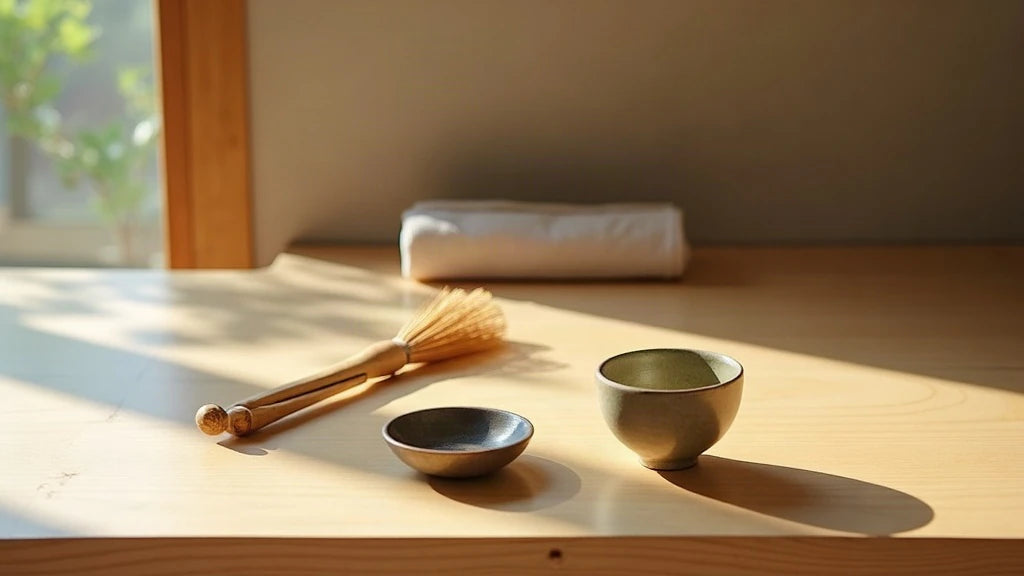

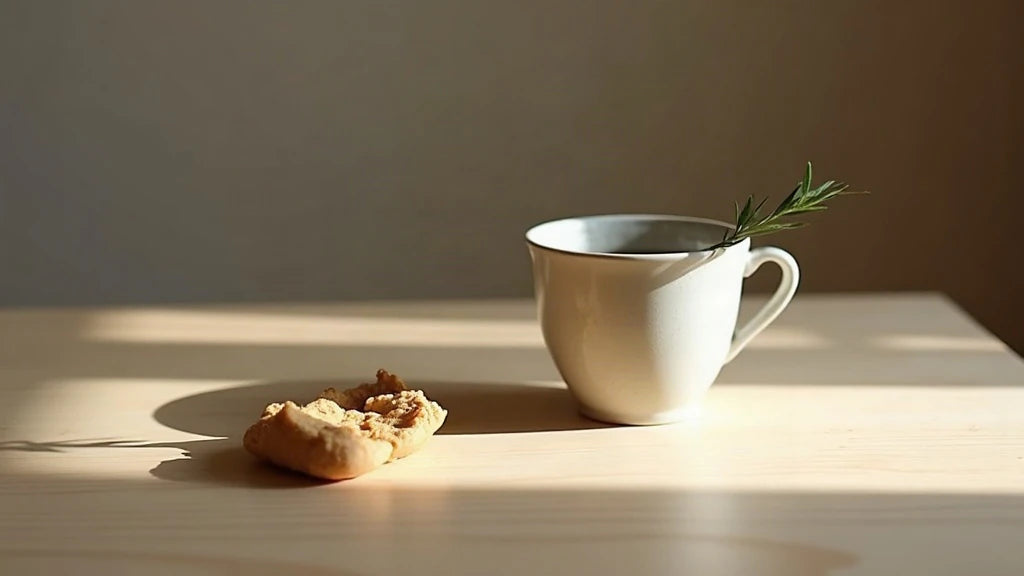
I once poured sencha into a wide ceramic mug because the cup cabinet was in a box, three days after a move. The tea went grassy, then sharp, then undrinkable, and I drank it anyway standing at the counter. That morning taught me more than any book: the vessel is part of the recipe. So when someone asks me tea cup or mug for loose leaf tea, which is better, the honest answer depends on the hour. A small Japanese tea cup suits short, attentive drinking, such as green tea in the morning or a pause mid-afternoon, because its thin walls and modest volume let the tea reach drinking temperature fast and finish before it turns bitter. A mug suits long sessions at a desk or in a reading chair, where you want 300 ml of roasted or black tea to stay hot for half an hour and a handle to carry it. Most people end up keeping both, and the real question becomes which ritual you are in, not which vessel is better.
Key points
- A Japanese tea cup is built for short drinking: thin walls, small volume, tea that cools into its best window within a minute.
- A mug is built for duration. Thick walls and more liquid hold heat longer, which suits roasted, black and herbal leaves far better than delicate green tea.
- Holding a handleless cup in both hands slows the pace and tells you the temperature; a handle frees your hand to keep working.
- Match the vessel to the moment, cup for a focused pause, mug for a long morning, and preheat whichever one you pick.
Japanese tea cup vs Western mug: what changes in the cup
Before any judgement, it helps to put the two objects side by side on a table and pick them up. They are not two versions of the same thing. They are two different tools, shaped by two different drinking habits, and nearly every difference between them comes down to three measurements: wall thickness, volume, and the presence of a handle.
The yunomi: thin walls, tall shape, no handle
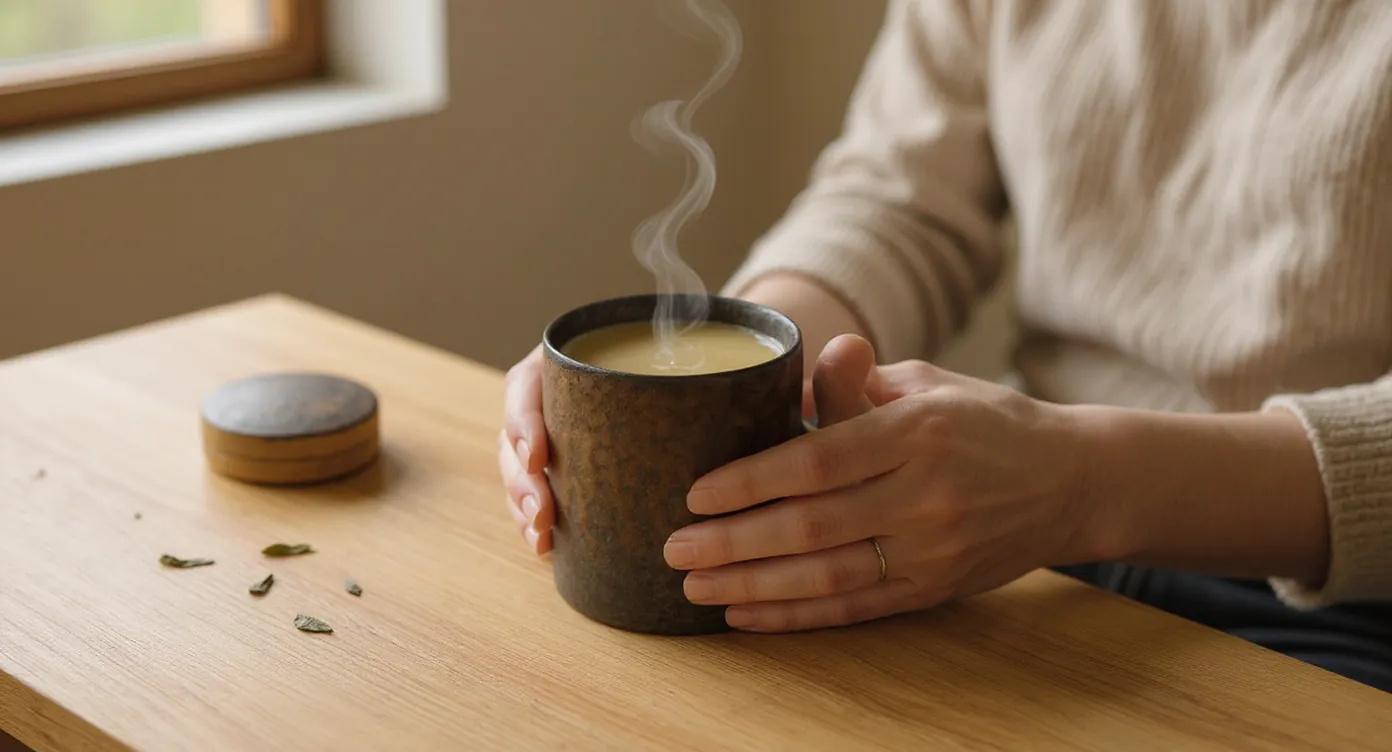
The everyday Japanese tea cup is called a yunomi, which simply means a cup for drinking hot water or tea at home, as opposed to the shallow bowl used in formal tea practice. It is taller than it is wide, holds roughly 120 to 180 ml, and its walls are thin, often in the 2 to 4 mm range. There is no handle. The foot is frequently left unglazed, a small ring of bare clay that tells you what the cup is actually made of. In the potters' villages I visited around Kyoto, this was the piece thrown fastest and sold cheapest, because every household needed four of them. That ordinariness is the point: a yunomi is a working object, not a display piece.
Thin walls change the drinking experience in a way you feel immediately. The ceramic itself absorbs very little heat from the tea, so the liquid loses its temperature mostly through the open surface rather than into the body of the cup. The tall, narrowish shape limits that open surface. The result is a cup that is hot to hold for twenty seconds, comfortable by the time you want to drink, and empty before the leaves at the bottom of your teapot have a chance to over-steep. If you want a tangible reference for that build, the one I reach for most often at home is this handmade Japanese tea cup, because its rim is thin enough to disappear against the lip, which is where most mass-produced cups fail.
The mug: thick body, 300 ml and up, a handle
A Western mug is designed around a different assumption: that you will drink slowly, over a long stretch, while doing something else. Its walls usually measure 6 to 8 mm, sometimes more on handmade pieces. Capacity starts around 300 ml and often reaches 400 ml. The body is wider, the base heavier, and a handle sits on the side so your fingers never touch the hot surface. All of this is coherent engineering for coffee, for strong black tea with milk, for a drink you want to still be warm forty minutes into a work session.
The thick wall does two jobs. First, it stores heat: a heavy ceramic body absorbs energy from the tea at the start, then gives it back slowly, which flattens the cooling curve. Second, it insulates your hand from the liquid, which is only possible because the handle removes the need to grip the body at all. The cost is precision. A mug is a poor instrument for anything that needs to be drunk within a narrow temperature window, because it will hold your tea above that window for longer than the leaves can tolerate.
Tea cup or mug, side by side
Laid out as numbers, the gap is clearer than any description. The figures below are typical ranges for handmade pieces rather than fixed specifications, and a thick artisan cup or a thin fine-bone mug will sit outside them. Use them as orders of magnitude, not as rules.
Heat retention: does a tea cup or a mug hold tea longer?
A mug holds heat longer. That is settled, and it is also the wrong place to stop. The useful question is not which vessel keeps tea hot, but which one keeps tea at the temperature that particular leaf tastes best at, for as long as you need. On that measure the small cup wins for green tea and loses for everything you drink slowly.

Why a small tea cup brings green tea into its window
Japanese green tea is not meant to be drunk scalding. Sencha is commonly brewed between 70 and 80 °C, and it is most pleasant in the mouth somewhere around 60 to 70 °C, where the sweetness and the marine note sit forward and the astringency stays in the background. Water out of a kettle is far above that. A thin, small cup does the cooling for you: pour at 75 °C and within a minute or so you are inside the drinking window, without ice, without waiting, without a thermometer. The cup is not failing to retain heat. It is performing a deliberate, fast, controlled drop.
The small capacity matters just as much as the thin walls. A 150 ml serving is gone in four or five sips, which means the whole cup is consumed inside the good window rather than trailing off into a lukewarm third. This is also why a Japanese tea service brings several small pours rather than one large one: each pour from the kyusu teapot is fresh, each is drunk at its peak, and the leaves get a chance to open progressively across two or three infusions. At home, I keep a 150 ml cup beside the pot and refill it. That sounds like more work than it is, and it is the single change that improves most people's green tea.
How a thick mug keeps black tea hot for 30 minutes
With black tea, roasted tea or a herbal infusion, prolonged heat is not a liability. These leaves are brewed near boiling, they tolerate long steeping, and they taste right at 70 °C and still decent at 55 °C. Here the mug's thermal mass earns its keep. More liquid means more stored energy, thicker walls slow the transfer outward, and a narrower mouth relative to volume limits evaporative loss. A well-made thick mug will keep tea genuinely hot for twenty-five to forty minutes, depending on the room and whether you preheated it. That is the difference between finishing your tea and reheating it.
If you want to see that behaviour in a piece rather than a chart, the one I recommend most often to people who work at a desk all morning is this heavy-walled ceramic mug. I chose mine for a specific reason: the body is thick enough to carry heat through a long writing session, and the matte glazed stoneware surface grips the fingertips instead of sliding, which matters more than it sounds when your hands are dry in winter. It is the vessel I use for hojicha between seven and nine in the morning, and I almost never use it after midday.

Preheating the cup or the mug before pouring
Both vessels benefit from the same thirty-second habit, and for opposite reasons. Rinse the inside with hot water, swirl it, tip it out, then pour your tea. In a mug, preheating stops the cold ceramic from stealing fifteen or twenty degrees from your first pour, which is exactly the temperature drop that makes black tea taste flat and under-extracted. In a thin cup, preheating is less about the end temperature and more about consistency: a cold cup drops sencha below its window almost immediately, and you lose the aroma lift that comes in the first few seconds.
There is a second, quieter reason to do it. Ceramic that goes from cool to near-boiling in one step takes thermal stress, and over years that stress is what opens hairline crazing in a glaze. Warming the piece first is gentler on the glaze and on the clay beneath it. I rinse with the tail end of the kettle water while the leaves are still steeping, so it costs no extra time and no extra water. On a cold morning I leave the rinse water in the mug for a full minute before tipping it out.
Holding a handleless tea cup, or reaching for a mug handle
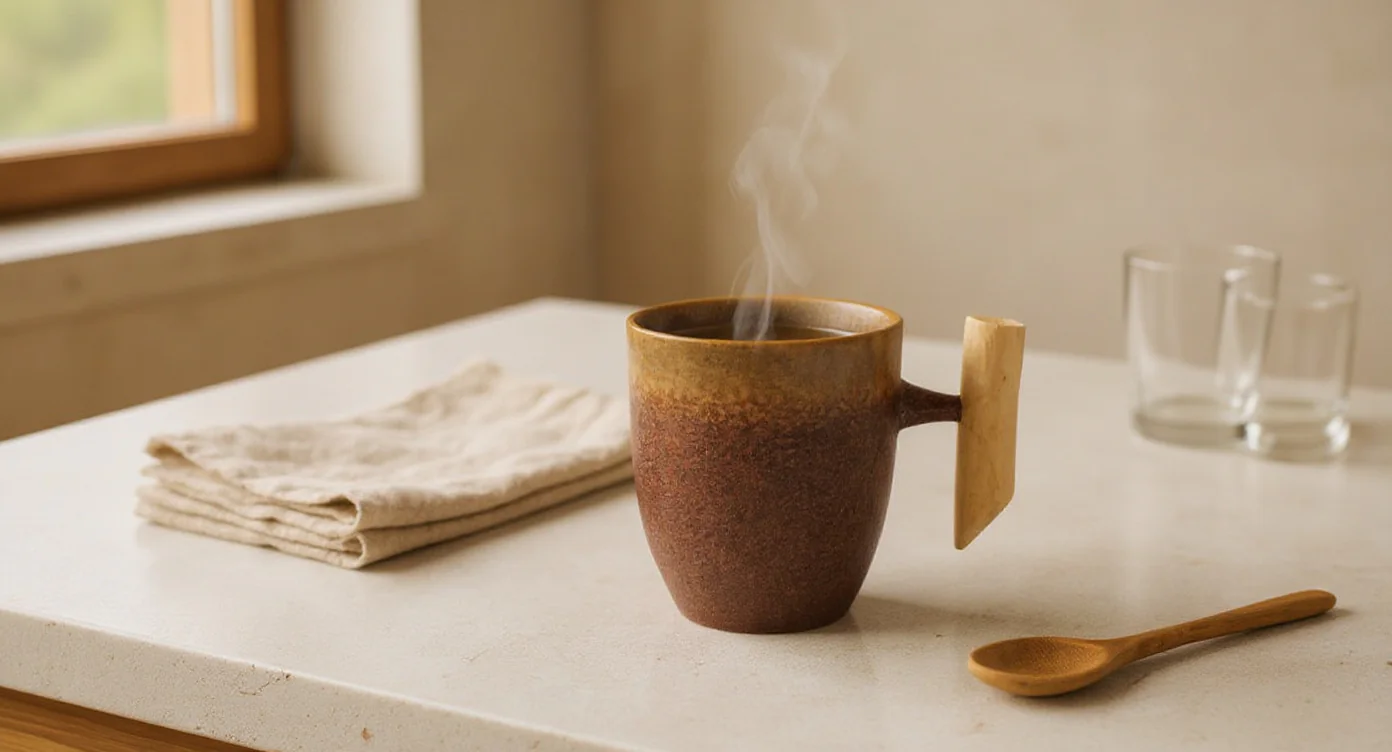
This is where the two objects stop being a thermal argument and become a question of posture. An object decides how you hold your body. A handleless cup asks for two hands, a lowered gaze and a pause. A handle asks for one hand and lets the other keep going. Neither is more virtuous. They simply belong to different parts of a day.
What your hands read from a handleless Japanese cup
A handleless tea cup turns your palms into a thermometer. You pick it up, and if it is too hot to hold it is too hot to drink, so you set it down and wait. That feedback loop is immediate and needs no instrument. It also stops you from scalding the tea's own aroma and your tongue at once. Over a few weeks the gesture becomes calibrated: you learn the exact degree of warmth that means this cup of sencha is ready, and you stop guessing.
The second effect is on pace. Both hands on the cup means neither hand is on a phone, a pen or a keyboard. The drink becomes the activity rather than the accompaniment. Ten minutes of that in the middle of an afternoon is a genuinely different experience from the same ten minutes with a mug beside a laptop. I notice it most in the rooms I style for clients: when I put a small handleless cup on a low side table beside a reading chair, people sit differently. They lean back. The object gives permission to do one thing at a time.
When a mug handle is simply the practical answer
I am not romantic about this. There are hours when a handle is the correct engineering. Carrying tea up a flight of stairs, holding a book open with the other hand, taking a call, cooking, working through email. A handle lets you move with hot liquid, and a handleless cup does not. Trying to force the slow ritual onto a busy morning does not produce calm. It produces a cold cup and a small daily irritation.
A good handle has a specific shape. The opening should take two fingers comfortably, not one squeezed finger, and it should sit high enough on the body that a full mug does not tip forward in your grip. On handmade pieces the handle is pulled and attached by hand, so there is natural variation from one piece to the next, and the join where it meets the body is worth looking at: a clean, slightly thickened join is a sign of a well-finished attachment. Check it with your thumb when the mug arrives rather than with your eyes.
Weight, balance and the unglazed foot of the cup
Weight is the detail most people overlook and the one they feel every single day. A cup that is too light reads as flimsy and skids on a table. A cup that is too heavy makes the two-handed hold tiring and turns a pause into a chore. The balance point matters more than the total mass. A cup with a slightly thicker base and thinner upper walls sits steady on a table, cools fast where the tea meets the air, and feels secure in the hand. That is the proportion good potters chase, and it is why two cups of identical volume can feel completely different.
Then there is the texture of the clay itself. Run a finger across the unglazed foot and you learn the body: smooth and dense, or slightly sandy with visible grit. The same variation runs across the glazed surface, where a matte or ash glaze keeps a faint tooth under the fingertips and a glossy glaze goes slick. Rim thickness is the last thing to check, because the lip is where your mouth meets the object. A thin rim delivers tea cleanly. A thick, rounded rim spreads the liquid and dulls the flavour slightly, which is forgivable in a mug of black tea and noticeable in a cup of gyokuro.
Which loose leaf teas suit a tea cup, which suit a mug
Sort by the leaf and the decision makes itself. The single variable that predicts which vessel to use is brewing temperature, and the second is steeping time. Delicate green leaves want cooler water and short infusions, which points to a small thin cup. Roasted, oxidised and herbal leaves want near-boiling water and long infusions, which points to a mug. The matching is less about preference and more about chemistry: each tea has a narrow window where it tastes best, and the right vessel keeps it there.
Sencha and gyokuro in a Japanese tea cup
Sencha is brewed around 70 to 80 °C for roughly one minute, and gyokuro, the shaded leaf, goes lower still, often 50 to 60 °C for two minutes or more. These are precise windows. Push the water hotter and the catechins extract faster than the amino acids, which is the chemistry behind that harsh, drying bitterness people blame on cheap tea when the real culprit was the kettle. A small cup supports this precision because it holds a portion you can drink immediately, inside the window, with nothing left to go cold and sour at the bottom.
These teas also reward attention, and the cup encourages it. Gyokuro in particular is a two-sip proposition: a thick, almost broth-like sweetness that you notice or miss depending on whether you are paying attention. Serve it in 40 to 60 ml, not 300. For everyday sencha I pour 120 to 150 ml at a time, two or three times from the same leaves, raising the water temperature slightly on each pour as the leaf gives up less. The cup capacity in ml is doing real work here: it is the portion size that keeps each pour fresh.
Hojicha, genmaicha and black tea in a mug
Hojicha is sencha roasted over charcoal or in a drum until the leaf turns reddish brown. Roasting burns off much of the astringency and most of the caffeine, which makes the tea forgiving: brew it at 90 to 100 °C, steep it for a minute or longer, let it sit in the mug while you work, and it will not turn against you. Genmaicha, green tea blended with roasted rice, behaves similarly. Black tea and most herbal infusions are the same story at higher temperatures still, built for boiling water and three to five minutes of contact.
These are the teas that belong in a mug, and the pairing is not a compromise. A roasted leaf tastes rounder when it stays hot, because the toasty aromatics keep lifting off the surface as you drink. Put hojicha in a thin 150 ml cup and you lose it in five minutes. Put sencha in a 350 ml mug and you lose it for the opposite reason. The vessel and the roast level should move together.
Steeping leaves in the cup vs brewing in a teapot
Dropping loose leaves straight into a mug works, with limits. The leaves sit in 350 ml of near-boiling water with no way out, so extraction continues for as long as the tea lasts. For hojicha, a rooibos or a robust black tea that is fine, and sometimes pleasant. For sencha it is a guaranteed failure: by sip four the brew has crossed from bright to bitter, and no amount of good leaf will save it. Steeping time is only controllable if you can separate the leaf from the water.
Two solutions, in order of preference. An infuser basket that sits in the mug lets you lift the leaves out at the right moment, and a wide basket is important here, because leaves need room to unfurl. Cramming them into a small mesh ball gives you weak, uneven tea. The better answer for green tea is a kyusu, the side-handled Japanese teapot, which brews the whole pot at once and lets you pour small servings into a cup as you go. That is the setup that makes the small cup make sense, and it is why cup and pot are usually bought together rather than separately.
Wabi Sabi Teapot
When I drink delicate sencha I brew it in a teapot and pour it out, so the leaves never sit in the water too long. It is the piece that lets you use either a cup or a mug without over-steeping.
View product →Morning mug or afternoon tea cup: choosing by your ritual
Forget the abstract comparison and look at your actual day. Where do you drink tea, and what else are your hands doing while you drink it? Answer that and the question of tea cup or mug for loose leaf tea stops being a matter of taste and becomes a matter of scheduling. Most households need one of each, and they get used at predictable hours.
The long morning mug, for a slow start
Early morning is usually active, even when it is unhurried: you are reading, writing, moving between rooms, answering the first messages. A mug fits that shape. It holds enough that you are not standing up for a refill every ten minutes, it stays hot through a long stretch, and the handle means you can carry it from the kitchen to the desk without concentrating. Fill it with hojicha, genmaicha or a black tea, preheat it, and it will still be warm when you remember it exists.
Placement matters more than people expect. I keep the mug on the right of the work surface, past the edge of the keyboard, where a knocked elbow cannot reach it. On an open kitchen shelf I keep the morning mug at the front, within one reach, and the afternoon cups behind. That sounds trivial. In practice, the object you can reach without thinking is the object you use, and the ritual you want to build should be the easiest one to start.
A small tea cup for the afternoon pause
The mid-afternoon break has a different purpose. It is short, deliberate, and its value lies in the interruption. This is the hour for a small handleless cup and a green tea, because the cup enforces the pause: both hands occupied, four or five sips, five to ten minutes, done. You cannot multitask with it, which is precisely what makes it restful. I style reading corners around this moment: a low side table at armrest height, a cup, a coaster of pale oak or linen, nothing else on the surface.
Light is part of it too. Afternoon light is lower and warmer, and it lands differently on a matte glaze than on a glossy one. An ash or oatmeal glaze picks up the side light and shows its variation, the pooling at the base, the places where the glaze thins at the rim. This is the wabi-sabi part of the practice, the appreciation of irregularity and of marks left by time: the cup is more interesting at four in the afternoon than it was under the kitchen light at seven in the morning, and the small ritual gives you a reason to look.
Evening hojicha, and why a wood cup stays kind to the hands
Evening tea is almost always roasted at my house, because hojicha carries far less caffeine than sencha and the toasty aroma suits low light. It is also brewed hot and drunk slowly, which puts it in the same thermal category as the morning mug. There is a third option for this hour that solves the handleless problem outright: wood. Wood is a natural insulator, so a turned wooden cup holds its contents hot while the outside stays merely warm to the fingers. You get the two-handed hold without the need to wait for the ceramic to cool.
The cup I pick up most on winter evenings is this turned wooden tea cup, and the reason is honest and small: my hands are cold by nine at night, and a wood cup is the only vessel that is comfortable to cradle from the first second to the last. It is also quieter on a wooden table than ceramic. Treat it as a hand-wash-only object, keep it away from the dishwasher and prolonged soaking, and the grain will darken slowly into a patina that no new piece can imitate. That slow darkening is, to me, the clearest argument for buying fewer and better things.
One tea cup, one mug: building a shelf that holds both
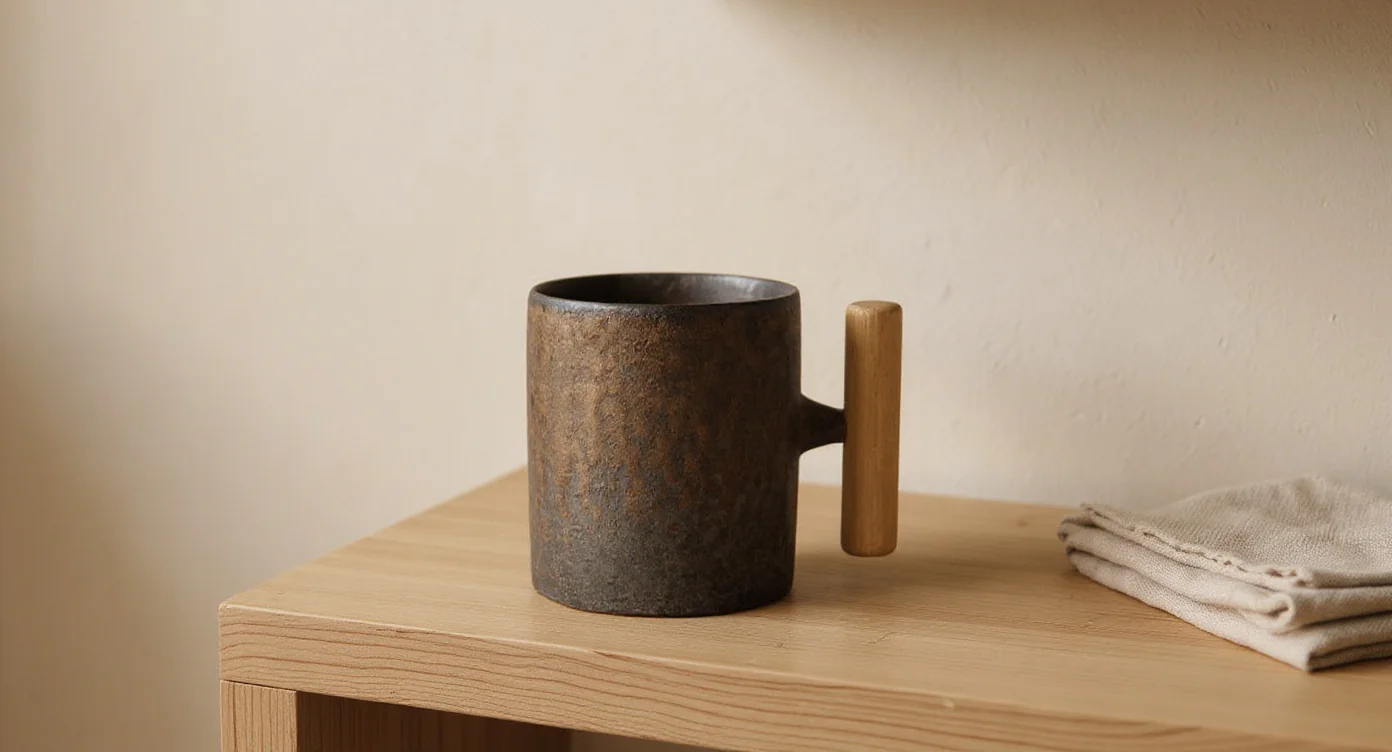
The conclusion of all this is not a larger cupboard. Most people drink tea in two or three recognisable situations, and two or three vessels cover them entirely. What ruins an open shelf is not the number of pieces but the mismatch between them: eight mugs from eight sources, in eight glazes, reading as visual noise. A small, coherent set does the same work and lets the eye rest. This section walks through how to choose and arrange pieces that belong together.

How many tea cups and mugs you actually need
For one person who drinks tea daily, I suggest two cups and one mug. The second cup is not redundancy, it is for the person sitting opposite you, and in Japan cups are traditionally sold in pairs or sets of five for exactly that reason. For a couple, two cups and two mugs. For a household that hosts often, add a set of four small cups, kept together, used together. Beyond that you are storing objects rather than using them, and every additional piece dilutes the ones you like most.
Buying in that order has a practical benefit too. A small set gets used constantly, which means you learn it: which cup suits which tea, how fast each one cools, which rim you prefer. That knowledge is what turns a cupboard into a practice. A large, half-known collection never gets there, because no single piece is used often enough to become familiar. This is the fewer, better choices principle applied to something you touch twice a day.
Pairing a cup and a mug from the same glaze family
Coherence does not mean matching. Pieces from the same glaze family, an oatmeal, a soft grey, a warm clay brown, sit together calmly even when their shapes and sizes differ, and the variation between individual handmade pieces is what keeps the group from looking manufactured. Vary the height, keep the tones close. A 180 ml cup beside a 350 ml mug in related glazes gives you the rhythm of different heights without introducing a colour clash.
When someone is starting from nothing, I usually suggest beginning with a pair rather than a single piece. A set of two matching mugs is the choice I make most often for clients staging a kitchen, because two coherent pieces on an open shelf photograph and live better than six unrelated ones, and because the second mug always finds a use. Then add the small cups separately, in a glaze from the same family. Leave physical space between the groups on the shelf. That emptiness is not wasted space, it is what lets each piece be seen.

Caring for glazed ceramic: washing, stacking, aging
Hand washing is the simple answer, with warm water and a soft cloth, and it takes less time than loading a machine. Dishwashers are hard on handmade ceramics in two specific ways: high-pressure jets chip rims and feet where pieces knock together, and strong detergents dull matte and unglazed surfaces over time. If a maker states a piece is dishwasher safe, that is their specification to make, not mine to guess at. For anything thin-walled or matte I would wash by hand regardless, and check the maker's own care instructions rather than assume.
Stacking is the other quiet source of damage. Thin rims are the most vulnerable part of any cup, so stack only pieces designed to nest, and if you must stack, put a square of felt or a folded cloth between them. Store cups upright rather than inverted on a hard surface, which protects the rim from constant small pressure. With that minimal care, glazed ceramic ages well: tiny glaze crazing appears as a faint network of lines, the unglazed foot darkens slightly where it meets the table, and roasted tea leaves the faintest warmth in the clay. None of that is damage. It is the record of use, and it is the part of the object you cannot buy new.
FAQ
These questions come up often when people are learning the difference between the two vessels. Read them with your own morning and afternoon in mind, and let your answer be the ritual that already makes sense to you.
Can you brew loose leaf tea directly in a mug?
Yes, and it works well for roasted, black and herbal teas that tolerate long contact with hot water. It works poorly for delicate green teas, because you cannot remove the leaves and extraction keeps going until the mug is empty. If you want green tea in a mug, use a wide infuser basket and lift the leaves out at the right moment, or brew in a teapot and pour.
Why do Japanese tea cups have no handle?
Partly tradition and partly function. Green tea is served below boiling, so the cup is holdable without one, and the direct contact tells you whether the tea is ready to drink. Holding the cup in both hands also slows the drinking, which suits a tea meant to be tasted rather than consumed. A handleless cup is simpler to throw on the wheel, to stack and to store.
Does a mug make green tea bitter?
Indirectly, yes. The mug itself adds nothing to the taste, but its volume and heat retention keep green tea hot for longer than the leaf tolerates, and if the leaves stay in the water the brew over-extracts into bitterness. Use cooler water, around 70 to 80 °C, keep the serving small, and separate the leaves from the water on time. Do that and a mug of green tea is perfectly good.
Are Japanese tea cups dishwasher and microwave safe?
It depends entirely on the piece, so check the care instructions for the specific cup rather than assume. Many handmade glazed cups tolerate neither well: dishwashers chip rims and dull matte glazes, and uneven microwave heating is hard on thin walls and on any unglazed clay that has absorbed moisture. Hand washing in warm water is the safe default. Heat your tea in a kettle, not in the cup.
If you are curious which shape and glaze would suit your own afternoon pause, the Japanese tea cups collection is a good place to look slowly. Take the time to compare wall thickness and capacity before anything else, and let the glaze be the last decision.
Explore the Japanese Tea Cups collection
Browse the Japanese Tea Cups collection to find a handleless cup, a mug, or both, in glazes that sit well together on an open shelf.
Browse the collection →