

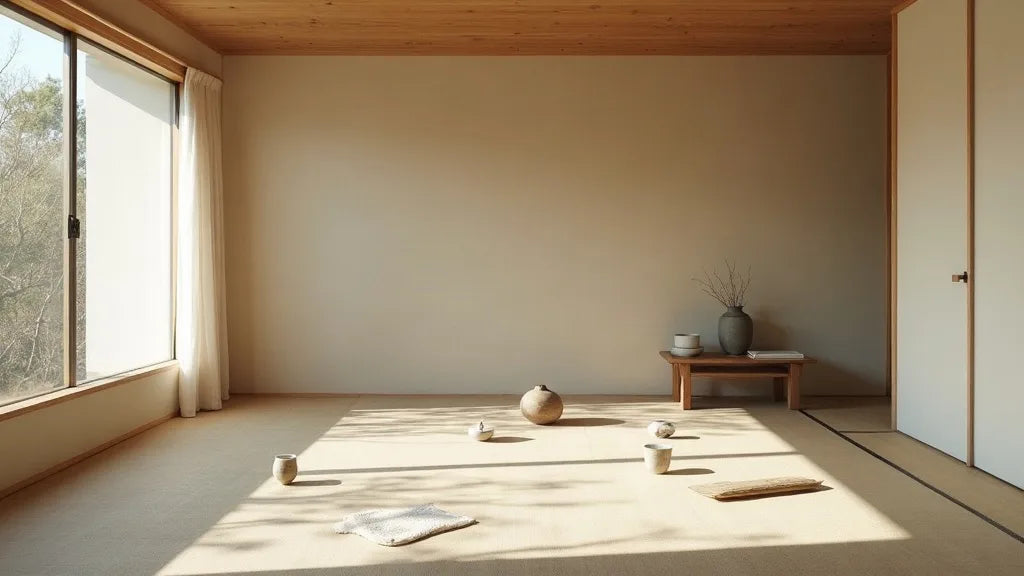
The first time I understood wabi-sabi, I was kneeling on tatami in a Kyoto machiya, holding a tea bowl that was visibly off-round. Nothing in the room was centred. Nothing was new. And the room was calmer than any showroom I had ever styled. The 7 principles of wabi sabi are kanso (simplicity), fukinsei (asymmetry), shizen (naturalness), shibumi (understated depth), yugen (suggestion rather than display), datsuzoku (freedom from routine) and seijaku (stillness). They come from Zen aesthetics, not from interior design, but each one translates into a very concrete decorating gesture: what you remove, how you place it, which material you touch. Below, we take them one by one and turn each into something you can do in a real room this weekend.
In short
- The seven principles are kanso, fukinsei, shizen, shibumi, yugen, datsuzoku and seijaku: seven Zen aesthetic ideas, not decorating rules.
- Each principle becomes a physical gesture: subtract objects, break the symmetry, choose raw materials, leave empty space.
- Wabi-sabi is not the same as minimalism: it keeps texture, patina and irregularity instead of erasing them.
- You can apply all seven in a rented flat with almost no purchases. Placement and light do most of the work.
What are the 7 principles of wabi-sabi?
They are seven qualities used to describe Zen art and, by extension, Zen-influenced spaces. Read them as directions rather than rules: each one tells you what to do less of.
Where the wabi-sabi principles come from (wabi, sabi, Zen)
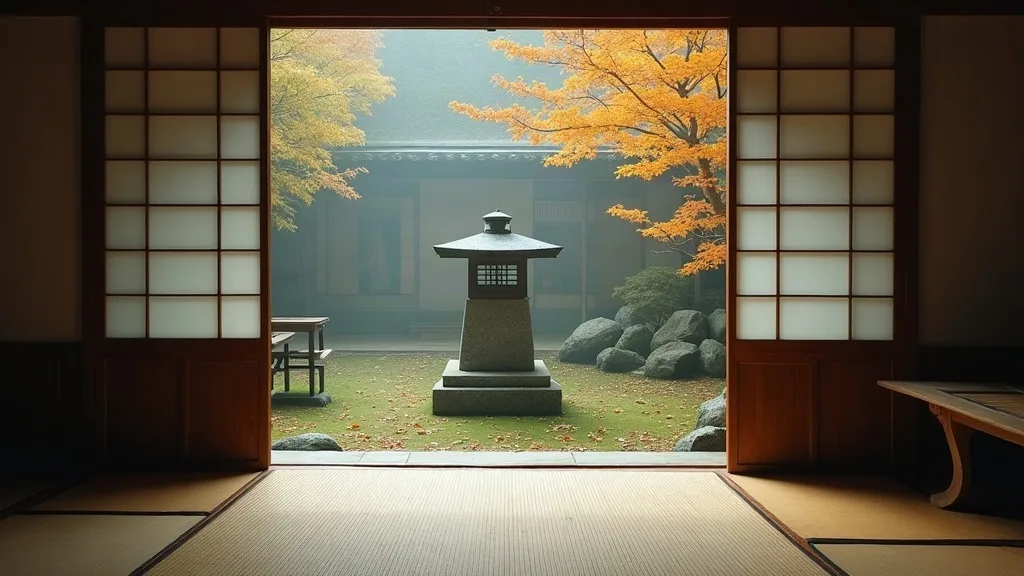
Wabi once described the loneliness of living simply, away from society. Sabi described the beauty that arrives with age and wear. Joined together, they name a taste for things that are modest, weathered and unfinished. The seven principles themselves are usually traced to twentieth-century writing on Zen aesthetics and the arts it shaped: tea ceremony, ink painting, garden design, ceramics. None of it was written for living rooms. That is exactly why it works so well in one.
The 7 wabi-sabi principles at a glance
Here is the whole set, with the gesture each one asks of you.
| Principle | Meaning | What it looks like in a room |
|---|---|---|
| Kanso 簡素 | Simplicity, plainness | Clear a surface completely, then put back only what earns its place |
| Fukinsei 不均整 | Asymmetry, irregularity | Move the vase off the centre of the console; hang art off-axis |
| Shizen 自然 | Naturalness, no pretence | Linen, clay, stone, paper, wood left close to its raw state |
| Shibumi 渋み | Understated, quiet depth | One matte, unremarkable piece that holds the eye longer than a shiny one |
| Yugen 幽玄 | Subtle suggestion, mystery | Half-hidden views, layered light, a corner you cannot see all at once |
| Datsuzoku 脱俗 | Freedom from routine | A floor-level tea ritual, a screen-free chair, an unexpected empty wall |
| Seijaku 静寂 | Stillness, active calm | A pocket of the home with no task attached to it |
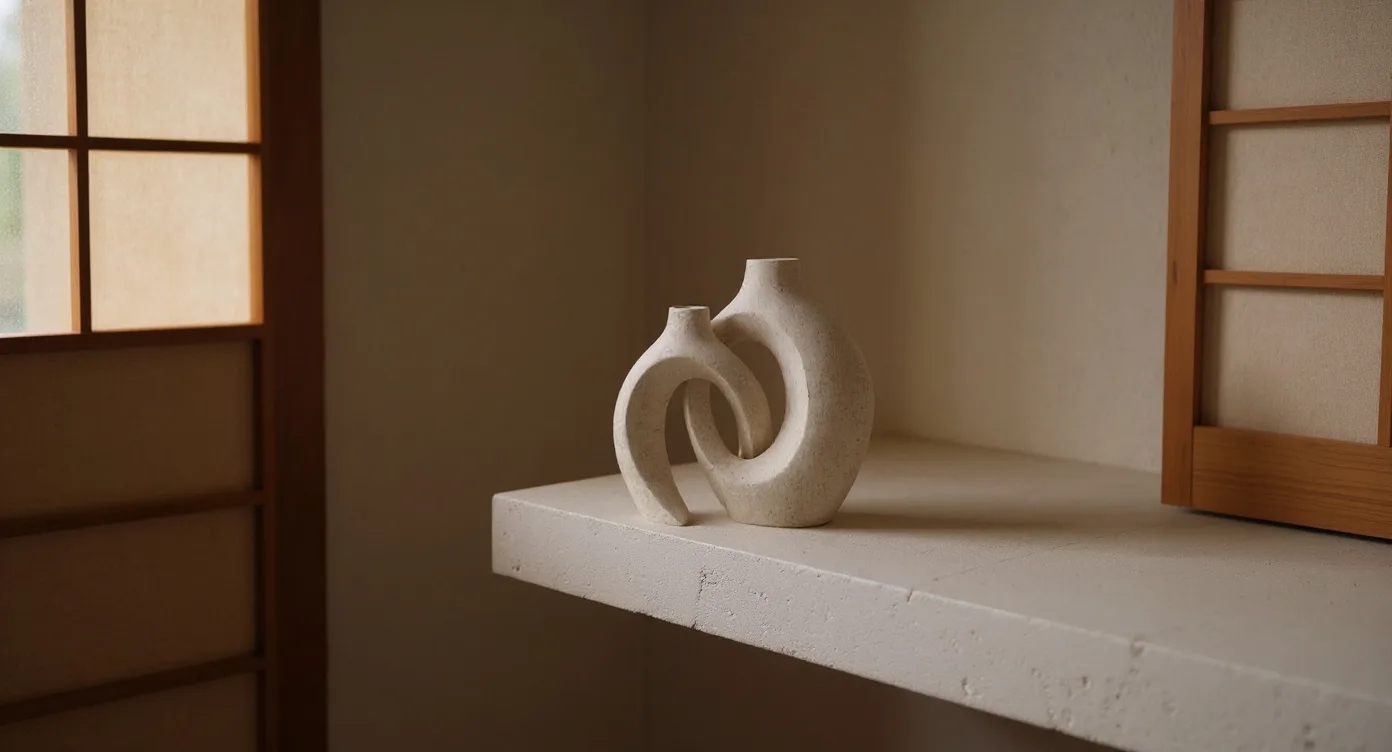
Fukinsei is the easiest to see and the hardest to fake. A silhouette that leans, a rim that dips on one side, a glaze that pools unevenly: these read as alive. The piece I reach for most often to demonstrate this is a sculptural vase with an irregular profile, because it changes shape as you walk past it.
Wabi-sabi is not minimalism: one key difference
Minimalism removes texture along with clutter. Wabi-sabi removes clutter and keeps texture. A minimalist shelf is smooth, white and empty; a wabi-sabi shelf is nearly empty and every surface on it has grain, pores or a chipped edge. The beauty of imperfection is the whole point, so a hairline crack, a knot in the oak or a colour shift between two bowls is not a defect to hide.
Kanso and fukinsei: subtraction and off-centre balance
These two do most of the visible work. Kanso decides how much stays. Fukinsei decides where it goes. Together they will change a room faster than any purchase.

Kanso in practice: how much to remove from a shelf
Empty the surface entirely, onto the floor. Put back three objects, no more, and live with them for a week. Anything you did not miss goes to another room or out. In home staging I use the same method on sightlines: stand in the doorway, look straight ahead, and remove whatever interrupts that first line of view. Circulation comes before decoration.
Fukinsei: styling in odd numbers and uneven heights
Symmetry tells the eye that everything has been resolved, so the eye stops looking. Asymmetry keeps it moving. Group in threes, with three clearly different heights: tall, mid, low. Slide the group off the centre of the console, roughly a third of the way in. Above a bed, hang a single piece off-axis rather than two matching frames. On a dining table, place the bowl slightly closer to one end.
The rule of three that keeps a wabi-sabi surface calm
Three objects, three heights, three textures. One rough element (stone, unglazed clay), one soft element (linen, paper), one living element (a single branch, not a bouquet). Then leave the rest of the surface bare, because that emptiness is a component, not a gap. Japanese design calls it negative space (ma): the interval that gives the objects their weight.
Shizen and shibumi in a wabi-sabi interior: materials
Once the placement is right, materials carry the mood. Shizen asks for materials that still look like what they are. Shibumi asks that none of them shout. This is where I spend the most time when I check pieces in a workshop: how the surface reads in daylight, and how it will read in three years.
Shizen: linen, clay, stone, paper and untreated wood
A truly natural material tells you so with your hands. Washed linen creases and refuses to lie flat. Travertin has open pores you can feel with a fingertip. Unglazed ceramics stay slightly porous and cool, and darken faintly where they are touched. Pale oak and paper-thin washi both change tone with the light. If a surface looks the same from every angle and at every hour, it is probably a print of a material rather than the material.
Shibumi: why the quietest piece wins the room
Shibumi is depth without display. In a room, it is usually the piece nobody comments on and everybody touches. Low seating lowers the whole sightline and makes ceilings feel taller. The one I recommend most often for a reading corner is a Japanese sitting cushion in natural fabric: it takes almost no visual space, it softens a hard floor, and it slides against a wall when you need the room back.

Reading patina: what ages well and what just wears out
Not all wear is beautiful. Patina and aging improve materials that are solid all the way through; they ruin materials that are only a surface.
| Material | How it ages | Verdict |
|---|---|---|
| Solid oak, oiled | Darkens, absorbs marks, can be re-oiled | Ages well |
| Unglazed or matte stoneware | Softens in tone, chips become part of the object | Ages well |
| Veneer with a printed grain | Edges lift, the print scratches to a pale core | Wears out |
| High-gloss lacquer | Every scratch reads as damage | Wears out |
This is the logic behind kintsugi, the Japanese repair that joins broken ceramic with lacquer and gold powder rather than hiding the break. The object keeps its history in plain view.
Yugen, datsuzoku, seijaku: the wabi-sabi you feel
The last three principles are not about objects at all. They are about what you can only half see, what breaks your habits, and what stays quiet. They cost nothing and they are the ones people notice when they walk in.
Yugen: half-hidden views, layered light and depth
Yugen is suggestion instead of full display. Never let a room reveal itself in one glance. A linen curtain that filters the window rather than framing it. A branch that partly crosses a piece of art. A bookshelf you see at an angle from the doorway. For light, work in layers and keep it low: one floor lamp, one table lamp, one candle, and no ceiling light after dark. Shadow is a material here.
Datsuzoku: breaking the routine with a floor-level ritual
Datsuzoku means stepping outside the ordinary. It is a use, not a purchase. Sit on the floor for one cup of tea a day, with a low tray and nothing else within reach. Whisking matcha takes two minutes and it is impossible to do while scrolling. A kyusu, the side-handled Japanese teapot, makes the gesture slower on purpose.
Seijaku: designing a pocket of stillness at home
Seijaku is stillness that feels alive rather than empty. Choose one square metre in the home and give it no function: no charger, no paperwork, no screen. A stone incense burner marks a boundary between outside and inside. Keep the palette in that corner tight, a muted earth palette of clay, sand, ash and unbleached linen, so the eye has nothing to resolve.
Applying the wabi-sabi principles room by room
Principles are easier to hold once they are attached to a room. Each space below activates two of the seven, with three steps you can do without buying anything.
Wabi-sabi in the bedroom: one focal wall, no symmetry
Bedroom equals seijaku plus fukinsei. First, clear both nightstands and put back one object each, deliberately different. Second, break the matching lamps: keep one, move the other elsewhere, and add light on the opposite side at a different height. Third, choose one wall to carry everything (headboard, art, texture) and leave the other three bare.
Wabi-sabi in the reading corner and entryway
Reading corner equals shibumi plus datsuzoku. Set the chair or cushion at an angle to the wall, not flat against it. Add one light source at shoulder height, warm and dim. Keep a single stack of books, not a shelf. In the entryway: one bench, one bowl for keys, one mirror hung slightly off centre.
Wabi-sabi in the kitchen: open shelves and daily objects
Kitchen equals kanso plus shizen. Take one shelf, remove everything, and put back only the pieces you use every day: the bowl you eat from, the teapot, one wooden board. Mismatched is better than matched, since asymmetry in styling reads as lived-in rather than staged. Leave a third of the shelf empty. A linen cloth over the handle finishes the surface without adding an object.
FAQ about the 7 wabi-sabi principles
Short answers to the questions readers send me most often about applying these ideas at home.
What are the 7 principles of Zen aesthetics?
Kanso (simplicity), fukinsei (asymmetry), shizen (naturalness), shibumi or koko (austere, understated depth), yugen (subtle suggestion), datsuzoku (freedom from convention) and seijaku (stillness). They were formulated to describe Zen arts such as calligraphy, gardens and tea, then borrowed by designers.
What is the opposite of wabi-sabi?
Anything symmetrical, glossy, mass-produced and permanently new. Think matched sets, high-shine surfaces, bright even lighting and rooms designed to look finished. Wabi-sabi accepts that a room is never finished.
Is wabi-sabi a real concept or a modern trend?
It is a real aesthetic vocabulary with centuries of use in Japanese tea culture, ceramics and architecture. What is modern is the interiors packaging around it. Treat it as a way of looking, not as a style to install.
Are there really only seven wabi-sabi principles?
Seven is the most cited number, but the lists differ. Some include koko instead of shibumi, some add ideas such as ma, the meaningful interval. The count matters less than the direction: subtract, keep it natural, let it age.
Can I apply wabi-sabi in a small rented apartment?
Yes, and small rooms often respond faster. Nothing here requires structural work: you subtract objects, move furniture off the centre line, lower your lighting and swap synthetic textiles for linen or cotton over time. One empty corner in a small flat does more than a new piece of furniture.
If you want a starting point, our collection of calm, handmade home pieces is built around these same principles: irregular forms, natural materials, and objects that look better after a few years than on the first day.
Explore the Wabi Sabi Home Decor collection
Browse the pieces we use to apply these principles at home: clay vases, stone objects, linen cushions and low seating.
Browse the collection →